Aesthetics — Policy
Google Ads Disapprovals in Cosmetic Surgery: What Actually Triggers Them
Disapprovals in this category feel arbitrary because the notification says almost nothing. They are not arbitrary. In practice they come from two places, and once you know which two, most of them stop happening.
On this page
- Why the notification tells you nothing
- Trigger one: before-and-after imagery
- Trigger two: outcome language in the copy
- The less obvious causes
- How to appeal without making it worse
- A pre-flight checklist before you launch anything new
- The part that matters more than any of this
- Questions I get asked
Scope: disapprovals in aesthetics specifically — what triggers them, and how to appeal without making it worse. For certification and claims in regulated healthcare generally, see Running compliant Google Ads in regulated healthcare.
Why the notification tells you nothing
You get an email saying an ad was disapproved under the healthcare and medicines policy, or occasionally under personalized advertising. There are usually a dozen active assets and no indication of which one is the problem, or which element within it.
This is not Google being unhelpful for its own sake. Review is largely automated, the classifier flags a policy area rather than a specific string, and the same notice covers a wide range of underlying causes. The practical consequence is that guessing is expensive: each failed appeal costs days, and repeated failures on the same asset can escalate into account-level scrutiny you very much do not want.
So the useful move is not to appeal quickly. It is to diagnose correctly, fix, and then appeal once.
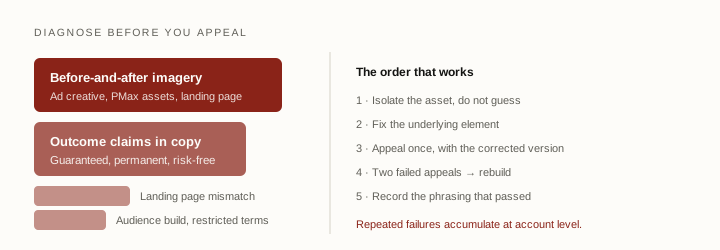
Trigger one: before-and-after imagery
This is the single most common cause in aesthetics, and it catches practices by surprise because the same images sit legally on their website and in their consultation room.
The issue is not that the photographs are inappropriate. It is that a direct visual comparison of a body part before and after a procedure functions as a performance claim, and advertising policy treats implied guarantees of outcome carefully across all health-adjacent categories. Split-screen creative, sliders, and arrow-annotated pairs all fall into the same bucket.
What this means practically:
- Keep before-and-after galleries off the pages you send paid traffic to. Deeper site pages are a different matter, but the landing page attached to an ad is reviewed as part of the ad.
- Image assets in Performance Max and Display carry the same exposure. Asset libraries assembled by a designer without policy context are a frequent source of surprise disapprovals.
- Single images of a result, without the comparison, generally sit differently — but the closer the framing gets to implying a guaranteed transformation, the more risk it carries.
Practices often resist this because before-and-after is genuinely their most persuasive asset. The workable compromise is to move the persuasion one click deeper: the ad and its landing page carry credentials, process, and consultation framing, and the gallery lives on a page the visitor chooses to open.
Trigger two: outcome language in the copy
The second cause is textual and it is subtler, because the offending phrases sound like ordinary marketing.
The pattern that draws attention is language that promises a result, implies certainty, or positions the procedure as risk-free. Superlatives about the practice are usually fine; assertions about what will happen to the patient's body are not.
"Get the body you've always wanted — guaranteed results"
"Board-certified surgeons. Book a consultation to discuss your options."
"Permanent fat removal with zero downtime"
"Non-surgical body contouring. See if you're a candidate."
"Look 10 years younger in one visit"
"Facial rejuvenation tailored to you — consultation first."
Notice what the compliant versions have in common: they describe the service and invite a conversation, rather than describing the outcome and asserting it. That reframing is also, in my experience, better performing copy in this category — people considering surgery are evaluating a surgeon, not buying a promise, and copy that respects that converts better into attended consultations even when it converts fewer clicks.
The less obvious causes
When it is neither of the above, these are the next places to look, roughly in order of frequency.
| Cause | What to check |
|---|---|
| Landing page mismatch | The ad promotes one procedure, the page covers everything. Review considers the destination, not just the ad. |
| Missing trust signals on the page | No practitioner credentials, no physical address, no contact route. Health-adjacent destinations are held to a higher bar. |
| Remarketing audience construction | Building lists from pages that reveal a health interest can fall under personalized advertising restrictions. This one surprises people because it lives in Audiences, not in the ad. |
| Third-party embeds on the landing page | Chat widgets and booking tools that inject content the reviewer sees but you did not write. |
| Prescription-adjacent terms | Branded injectable and pharmaceutical names carry their own restrictions independent of the surgical policy. |
How to appeal without making it worse
Diagnose before you appeal
Isolate the asset. If a responsive search ad was disapproved, the cause is one headline or description, not the whole thing — and you can find it by pausing suspects rather than guessing. If it is a Performance Max asset group, the image library is the first place to look.
Fix, then appeal with the corrected version
Appealing an unchanged asset is asking a second reviewer to disagree with the first, and the odds are poor. Google's own guidance on fixing a disapproved ad is explicit that you update the content and resubmit. Appealing a corrected version is asking them to review something new, and the odds are much better. This is the single most important habit here.
Do not appeal repeatedly on the same asset
Two failed appeals on the same creative is a signal to stop and rebuild rather than push. Repeated policy failures accumulate at account level, and an account-level suspension in a category this expensive is a genuinely serious event — you lose not just the ads but the conversion history the bidding depends on.
Do not let an old decision sit
As of July 2026 Google no longer accepts in-account appeals for policy decisions older than roughly six months; anything past that window has to go through support. In practice this means a disapproval you shelved last winter is now materially harder to reverse than one from last week. If there is a stale policy issue sitting in the account, deal with it before it ages out.
Keep a record of what passed
Every practice that runs in this category for a year ends up with an informal library of phrasing that works. Write it down. It saves the next person weeks, and it saves you from re-testing the same rejected phrase in a new campaign eighteen months later.
I run acquisition for a luxury US healthcare clinic inside a restricted advertising category, through a period when platform policy shifted mid-flight. The account kept running and kept scaling through it, with spend growing about 2× without a policy-driven restart. Compliance work is unglamorous and nobody hires you for it, but in restricted categories it is the difference between an account that compounds and one that keeps starting over.
A pre-flight checklist before you launch anything new
- No before-and-after comparison in any image asset, including Performance Max libraries.
- No before-and-after gallery on the landing page the ad points to.
- No headline or description asserting a guaranteed, permanent, or specific outcome.
- Practitioner credentials, physical address and a contact route visible on the landing page.
- Landing page matches the specific procedure the ad promotes.
- Remarketing lists not built from pages that disclose a specific health interest.
- Third-party widgets on the page reviewed for what they inject.
- A saved record of previously approved phrasing to draw from.
The part that matters more than any of this
Disapprovals are noisy and they feel urgent, so they absorb attention out of proportion to their cost. Worth keeping perspective: an ad that is running but optimizing toward the wrong conversion will waste far more money over a quarter than a week of disapproved assets.
Compliance is the price of entry in this category. It is not the thing that makes an account work. If you have solved disapprovals and your consultations still are not booking, the problem was never the policy — and that is a different piece of work entirely.
Questions I get asked
My competitor runs before-and-after ads. How?
Review is largely automated and enforcement is uneven — assets slip through and get caught later. Building a strategy on what a competitor is currently getting away with means building on something that can vanish overnight, taking the account's conversion history with it.
Does this apply to Meta as well?
Meta's restrictions in this category are generally stricter, particularly around imagery implying body dissatisfaction and around audience targeting on health interests. Copy that passes on Google is not automatically safe there.
How long does an appeal take?
Typically a few business days. If an account has repeated recent failures, longer — which is another reason to appeal once, correctly, rather than three times, hopefully.
Should I use Google's support to get this resolved?
Support can sometimes clarify which element triggered a flag, which is genuinely useful when a responsive ad carries a dozen assets. What they cannot do is override policy. Use them to diagnose, not to negotiate.
Can a disapproval get my whole account suspended?
A single disapproval, no. A pattern of repeated violations in the same policy area is what escalates to account level, and in this category that is a serious event — you lose the ads and the conversion history the bidding depends on. Two failed appeals on one asset is the point to stop and rebuild rather than push.
Do landing pages get reviewed, or just the ads?
Both. The destination is reviewed as part of the ad, which is why a compliant headline pointing at a page carrying a before-and-after gallery still gets pulled. Third-party chat and booking widgets count too, because they inject content the reviewer sees and you did not write.