Aesthetics
Why Plastic Surgery Ads Produce Consultations That Never Book
The enquiry count looks healthy. The surgical calendar does not. That gap is rarely a lead quality problem in the way most agencies describe it — it is a measurement problem that became a bidding problem.
On this page
- The five gates between a click and a procedure
- Why "lower the cost per lead" is the wrong instruction
- What optimizing toward the right thing looks like
- The signal volume problem, and how to work around it
- The leak nobody wants to hear about
- What to check this week
- What changes, and what it feels like
- Questions I get asked
The metric argument itself — why cost per lead is the wrong target — is in Cost per patient vs cost per lead. This page is about the specific place aesthetic funnels break, and what to do at each gate.
The five gates between a click and a procedure
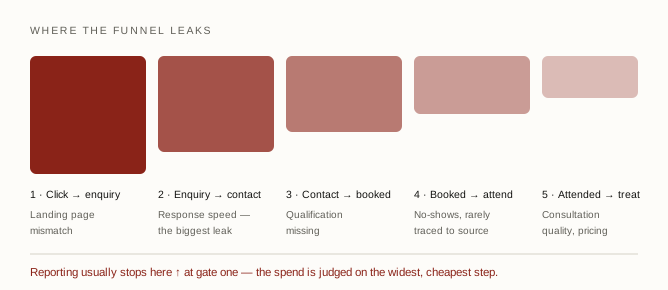
Aesthetics has one of the longest and leakiest funnels in elective healthcare. Between someone clicking an ad and someone paying for surgery there are five distinct gates, and most practices only measure the first.
| Gate | Where it usually leaks |
|---|---|
| 1. Click → enquiry | Landing page mismatch. The ad promised a procedure; the page is a generic homepage. |
| 2. Enquiry → contact made | Response speed. The largest and most fixable leak in the entire funnel. |
| 3. Contact → consultation booked | Qualification. Budget, candidacy, and timing surface here — or they should. |
| 4. Booked → attended | No-shows. Frequently a fifth or more of bookings, and almost never tracked back to source. |
| 5. Attended → treatment | Consultation quality and price positioning. Not a marketing problem, but it changes what marketing is worth. |
When an owner tells me the leads are bad, the honest answer is usually that gates two and four are where the money went, and nobody has looked at them because the reporting stops at gate one.
Why "lower the cost per lead" is the wrong instruction
This is the request I hear most often and it is almost always counterproductive.
Cost per lead can always be reduced. Broaden the targeting, soften the offer, drop the qualifying question from the form, bid on cheaper informational queries. Enquiry volume rises and cost per enquiry falls. The dashboard improves in every visible way.
What has actually happened is that you bought a cheaper audience. The people who arrive from "how much does a facelift cost" are at a different stage than the people searching for a named procedure with the word "surgeon" attached. Both count as one conversion. Only one of them books.
So the number goes down, the schedule stays empty, and six months later the practice concludes that Google Ads does not work for aesthetics. It works. It was pointed at the wrong target.
What optimizing toward the right thing looks like
The correction is mechanical, not creative. It has three parts.
Capture the click identifier on every enquiry
When someone arrives from an ad, Google appends an identifier to the URL. It has to be stored on the lead record — hidden form field, plus call tracking for phone enquiries. Without it, nothing downstream is possible. This breaks more often than anyone expects: embedded booking widgets strip it, old redirects lose it, and phone calls without call tracking never had one.
Send attended consultations back to the platform
Not bookings — attended. Mechanically this is an offline conversion import. No-show rates in aesthetics are high enough that optimizing toward bookings teaches the algorithm to find people who reserve slots and disappear. Once attended consultations flow back, bidding starts hunting for the audience that actually turns up.
Differentiate the value
A consultation for a full facelift and a consultation for a single filler session should not carry the same conversion value, because they do not carry the same revenue. Once values differ, the algorithm stops chasing volume and starts weighting toward the procedures that fund the practice.
The signal volume problem, and how to work around it
There is a constraint here that most write-ups skip, and it is the reason this work gets implemented and then abandoned.
Smart Bidding learns from repetition. A practice performing a dozen surgical procedures a month cannot feed the algorithm a dozen events a month and expect a pattern to emerge — it will either thrash between audiences or quietly stop spending. This is not a flaw in the method. It is arithmetic, and any consultant who does not raise it before starting has not run into it yet.
The way through is to separate the two jobs that everyone conflates. Bidding should be pointed at the earliest event that happens often enough to teach — a qualified enquiry, or a booked consultation — while judgement stays anchored to cost per attended consultation and cost per treatment. One is a training signal, the other is the scoreboard. Accounts with perfect tracking still get managed badly when those two collapse into a single number.
Practically, that means the mid-funnel event is what flows back to the platform on a short cycle, and the surgical outcome is reconciled monthly in your own reporting. It is less elegant than a single number, and it is the arrangement that survives contact with a real practice calendar.
On a luxury US healthcare clinic — elective, high-ticket, phone-driven — I inherited an account that had spent heavily for months with very little to show. Rather than adding budget, I cut it and rebuilt tracking so that verified patients, not enquiries, flowed back into the platform. Cost per verified acquisition fell roughly 78% while spend scaled about 2× over the same period. The market did not change. The signal did.
The leak nobody wants to hear about
Before any of the above, there is a cheaper fix, and it is uncomfortable because it is not a marketing fix.
Aesthetic enquirers rarely contact one practice. They open several tabs, fill in three or four forms in a single sitting, and then get on with their day. The practice that responds first and substantively usually wins the consultation — not because it is better, but because it was there while the person was still thinking about it.
If enquiries submitted at 4pm are answered the following morning, no amount of bidding sophistication will recover that. I have seen practices spend months restructuring campaigns when the highest-return change available was answering the phone faster and calling web enquiries within ten minutes.
So before you touch the account: pull last month's enquiries, find the time each one came in and the time it was first contacted, and look at the median. If that number is measured in hours rather than minutes, start there.
What to check this week
- Median time from enquiry received to first contact attempt. If it is over an hour, this is your biggest opportunity.
- How many conversion actions are marked Primary in the account. More than two means bidding is being pulled in several directions.
- Whether attended consultations — not bookings — are recorded anywhere that ties back to the ad click.
- Your no-show rate, and whether it differs by traffic source. It usually does, dramatically.
- Whether a test enquiry from an ad click lands with a click identifier attached in your CRM.
- What your ads land on. Procedure-specific ads pointing at a generic homepage waste the most expensive click you buy.
What changes, and what it feels like
When an account switches from optimizing on enquiries to optimizing on attended consultations, the first visible effect is that enquiry volume falls. This is correct and expected — the account has stopped buying the cheap audience. It is also the moment most practices panic and revert.
Over the following two months, cost per attended consultation drops, the schedule fills with better-qualified people, and consultation-to-treatment conversion improves because the people arriving were pre-qualified by the bidding itself. Fewer leads, more patients. Those are different products, and until now you were buying the wrong one.
Questions I get asked
Is this a targeting problem I can fix with better keywords?
Negative keywords and tighter match types help, and they are worth doing. But they are a manual approximation of what the bidding algorithm will do automatically once it knows what a good outcome looks like. Keyword hygiene without outcome data is treating the symptom.
Should I be running Performance Max?
Not until attended consultations are flowing into the account. Performance Max amplifies whatever signal it receives — on enquiry-level data it will scale the wrong audience faster and with less visibility. Sequence matters: tracking, then structure, then automation.
Does any of this send patient data to Google?
No. Only a click identifier, an event label, a timestamp and a value are sent. No names, contact details or clinical information leave your systems. How your specific stack is configured is still a compliance question worth putting to counsel rather than to a marketer.
My agency says my industry just has a high cost per lead. Is that true?
Aesthetics is genuinely competitive and clicks are genuinely expensive. But a high cost per lead is not the same as an unimprovable cost per patient, and an agency that cannot tell you your cost per attended consultation is not in a position to say which one you have.
How long does it take before the change shows up?
Expect roughly thirty days of clean outcome data before bidding has anything to learn from, then two further months for cost per attended consultation to settle. The first month usually looks worse on lead volume. That is the account changing what it buys, not the account breaking.
Should I charge for consultations?
A consultation fee is the bluntest qualification filter available and it changes the economics of everything upstream — fewer enquiries, materially higher attendance, and a cleaner signal to send back to the platform. It is a clinical and commercial decision rather than a marketing one, but it is worth deciding deliberately instead of by default.