Inherited a wasteful account. Rebuilt it around verified patients.
A luxury US healthcare clinic was running a large Google Ads program that counted platform conversions as wins. I wired the CRM into the bidding loop and rebuilt the account around verified patients.
The situation
I inherited a Google Ads program at a luxury US healthcare clinic. On paper it looked healthy: the monthly report was full of conversions and the account had been running for a long time. In the clinic's own system, it told a different story — nobody could say which of those "conversions" had become an verified patient.
The account had been optimized for whatever the platform could count. Bidding chased form fills and modeled conversions, budget leaked onto junk queries, and there was no feedback loop connecting ad spend to closed, verified revenue. It was, in the most literal sense, a wasteful account that reported itself as a winning one.
What was actually broken
- Attribution: platform-modeled conversions were counted as outcomes; the CRM was never the source of truth.
- Tracking: no GCLID capture flowing into the CRM, so no way to tie a click to a verified patient.
- Structure: campaigns weren't segmented by the things that actually drive verified patients — payer type and treatment modality.
- Bidding: the algorithm optimized toward cheap conversions, not valuable patients, so it bought volume that never closed.
What I did
Wired the CRM into the bidding loop
Captured GCLID on every click and imported it into Salesforce, then sent verified-patient outcomes back to Google as offline conversions. From that point, bidding learned from verified patients instead of form fills.
Rebuilt the account around value
Restructured Performance Max by payer type and treatment modality, layered intent-tight Search underneath, and sculpted negatives so budget stopped flowing to queries that never convert. Target ROAS was set against CRM-confirmed revenue.
Launched Microsoft Ads as a verified second channel
Once Google was producing verified patients, opened Microsoft Ads on the same CRM-verified basis — reaching high-intent demand at a fraction of Google’s cost per click and reducing single-platform risk.
What I did — organic
Built organic and AI search in parallel
From near zero, developed content architecture, technical SEO, entity signals, and an llms.txt so the clinic began earning organic visibility and citations in AI answer engines — a second, compounding acquisition channel alongside paid.
Results
Within roughly six months (December 2025 to June 2026), the account was operating on a completely different basis — measured against verified patients in Salesforce rather than platform-reported conversions.
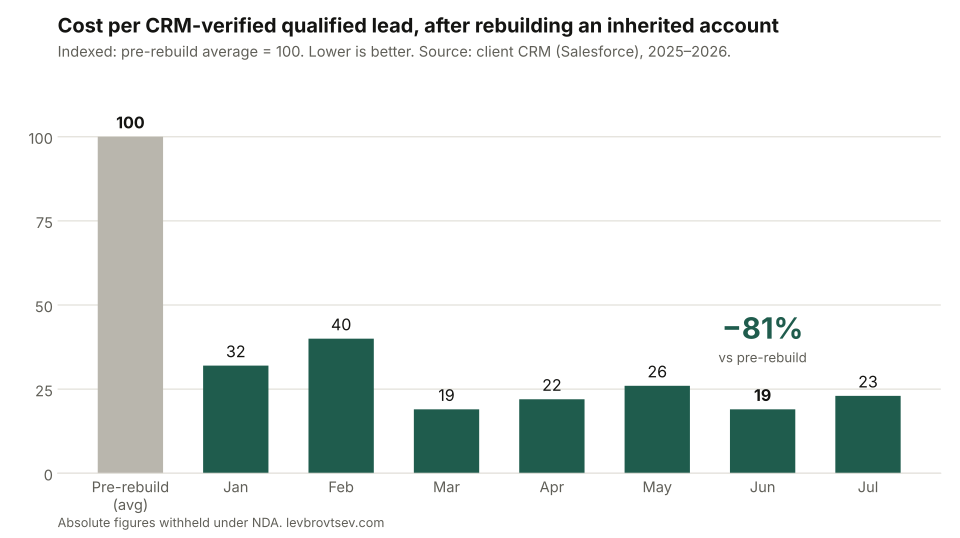
The chart tracks cost per CRM-verified qualified lead (−81% by June). The headline −78% is cost per verified patient.
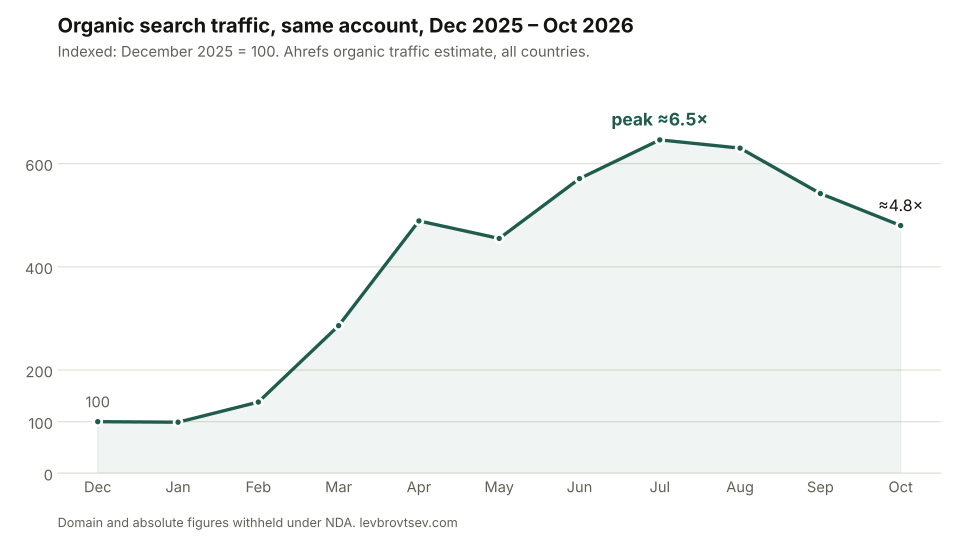
On the organic and AI-search side over the same window: roughly 6.4× US organic traffic, about 10× the Top-3 rankings, +5 DR (19 → 24), keyword footprint from ~300 to ~1.9K, and 600+ AI Overview and assistant citations built from a standing start.
Then the vertical got hit — and the system held
In May 2026, Google policy and algorithm updates hit the entire vertical. Costs spiked across the board; for one week, cost per verified patient ran well above target. Accounts built on platform-modeled conversions had no way to tell what was real.
This one did. Because bidding was anchored to CRM-verified patients, the right move was to hold steady and let the verification pipeline catch up rather than overreact to seven-day windows. Roughly ninety days later, cost per verified patient was about 50% below the Q1 benchmark — the best efficiency since launch. In parallel, Microsoft Ads was launched as a second channel, already producing verified patients at a fraction of Google’s cost per click.
Every figure above is verified against the client's CRM — closed, verified revenue — not platform-reported conversions. Absolute dollar values and the client's identity are withheld under confidentiality; results are shown in relative terms only.
"Lev is responsible for managing our paid acquisition channels and plays a key role in supporting our broader growth efforts, including close involvement in SEO. What stands out most is his ownership mindset and the level of control he maintains over the entire process."