Dental
8 Questions Every Dental Practice Should Ask Its Marketing Agency
Most practice owners cannot tell whether their marketing is working, because they have never been given a number that would settle it. These eight questions produce that number — or reveal that nobody has it.
On this page
This is the conversation version, written for dental practices: what to ask, and what an evasive answer to each question tells you. If you would rather run the checks yourself instead of asking, How to audit the agency running your ads is the same job as a checklist.
Why this is worth an uncomfortable conversation
Dental advertising is among the most expensive in Google. Clicks for implant and cosmetic terms routinely run into double digits, and a practice spending five figures a month is making a serious bet. Yet the standard monthly report — impressions, clicks, click-through rate, cost per lead — describes none of the things a bet is judged on.
This is not necessarily dishonesty. Many agencies genuinely cannot produce the number, because doing so requires connecting the ad account to the practice management software, and nobody set that up. The result is the same either way: you are funding a channel that nobody is measuring at the level that matters.
The questions below are not gotchas. A good agency will answer them readily and may well have raised them first. The point of asking is to find out quickly which kind you have.
| Ask | A good answer sounds like | Red flag |
|---|---|---|
| New patients from advertising, and how verified | Named source: practice management system matched to ad clicks | Lead counts offered instead of patient counts |
| Cost per patient by treatment type | Segmented by implant, cosmetic, hygiene | "We report on a blended basis" |
| Account ownership and admin access | Account in the practice's name, agency linked | Account created under agency billing |
| Fee structure and incentives | Flat fee, or a clear answer on what happens if spend drops | Percentage of spend with no answer to that question |
| What changed this month and what it produced | Specific actions with specific consequences | "We continued to optimise performance" |
| Call tracking and patient privacy | Knows which fields may and may not be transmitted | Has never considered the question |
| Budget constraint and marginal return | Quantified: constrained campaigns, projected return | "We could always do more with a bigger budget" |
| What you keep if the relationship ends | Answered without discomfort, itemised | Hesitation |
How many new patients did advertising produce last month, and how do you know?
The second half of the question is the important half. A number without a verification method is an estimate, and estimates in this business are consistently generous.
A good answer names the source: the practice management system, or the CRM, matched against ad clicks — mechanically, an offline conversion import. A weaker but honest answer is "we can't currently verify that, and here is what it would take to fix." Both are workable.
What does a new patient cost us, broken down by treatment type?
An implant patient and a hygiene patient do not carry the same value, and they should not carry the same acquisition cost. A blended average hides which part of the practice advertising is actually growing.
Practices are often surprised to find that the campaigns producing the most leads are producing the least revenue — because low-value enquiries are cheaper to generate, and blended reporting rewards volume.
Is the Google Ads account in the practice's name, and do we have admin access?
This is the question with the largest financial consequence and it is almost never asked until the relationship is ending.
If the agency owns the account, then the conversion history, the audience lists, the years of learning that make bidding effective — all of it stays with them when you leave. You do not restart from scratch; you restart from behind, because your competitors' accounts kept their history and yours did not.
How are we paying you, and how does that change your incentives?
A percentage of ad spend means your agency earns more when you spend more, regardless of whether spending more works. That is not a character flaw — it is a structure, and structures shape behaviour over time.
Flat retainers and hourly arrangements are cleaner. If a percentage arrangement is in place, ask directly what happens to their fee if they recommend cutting spend by a third. The answer to that question tells you everything about whose interest the recommendations serve.
What did you change this month, and what happened as a result?
A report that describes performance without describing action is a weather report. Somebody is being paid to make decisions; the decisions should be visible.
Look for specificity and for symmetry. "We paused four ad groups that had spent without producing consultations, added negatives around price-shopping queries, and shifted the freed budget to implant campaigns" is management. "We continued to optimise performance" is a sentence that could have been written before the month began.
How are phone calls tracked, and how do we handle patient privacy?
Most dental enquiries arrive by phone. If calls are not tracked to their source, the majority of your results are invisible and the account is optimizing on a minority of the data.
Equally, the answer should show awareness of what may and may not be passed to advertising platforms, and ideally of the HHS guidance on online tracking technologies. The correct position is that outcome events, click identifiers, timestamps and values may flow; patient names, contact details and anything clinical may not. An agency that has never thought about this line is one to watch carefully.
What are we losing to budget, and what would more spend actually buy?
If campaigns are constrained by budget while producing patients profitably, that is money left on the table and it is straightforward to quantify. If campaigns are unconstrained and still not producing, more budget will not help and the honest answer is to fix the account first.
Either answer is useful. A vague "we could always do more with a bigger budget" is not — it is a sales line wearing a strategy costume.
If we ended this tomorrow, what would we walk away with?
Ask before you need to know. The list should include the ad accounts and their history, the conversion tracking configuration, audience and customer lists, landing pages and creative, analytics access, and documentation of what was built and why.
A confident agency answers this without discomfort, because they expect to be kept on merit rather than through lock-in. Hesitation here is the most reliable signal on this page.
I took over a luxury US healthcare account that had spent heavily for months with almost nothing to show for it. Nothing was broken in an exotic way — the account was optimizing toward enquiries because nobody had ever connected outcomes back to it. Once verified patients flowed into the platform, verified patient volume rose around 9× on roughly 2× the spend. The previous arrangement was not unusual. It was normal, which is the problem.
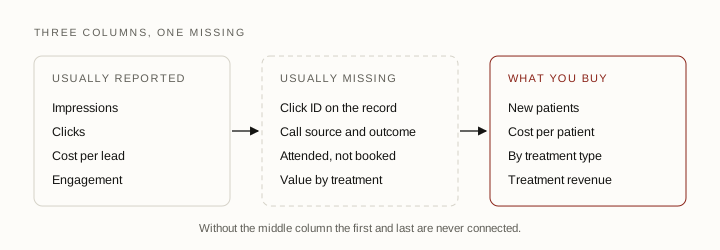
What a good monthly report contains
- Spend by channel and campaign, with the period clearly stated.
- New patients attributed to advertising, verified against the practice management system.
- Cost per new patient, split by treatment category rather than blended.
- What changed in the account this period, and what it produced.
- What is being stopped, and why.
- What is being tested next, and what result would count as success.
- Anything constrained by budget, with the projected return of removing the constraint.
Note what is not on that list: impressions, click-through rate, average position, engagement. Those are diagnostic details a specialist uses while working. They are not results, and a report built out of them is describing effort rather than outcome.
If the answers are bad
Do not start by firing anyone. Start by fixing ownership and measurement, because those two things determine whether any future arrangement can be judged at all.
Get the ad account into the practice's name with you as admin. Get call tracking in place. Get the connection built between ad clicks and your practice management system so that patient outcomes can flow back. Once those exist, the quality of any agency — including a new one — becomes visible within about sixty days.
The uncomfortable part is that a practice with no measurement cannot tell a good agency from a bad one, and so tends to change agencies based on how pleasant the account manager is. Measurement is what converts that decision from a feeling into a fact.
Questions I get asked
Our agency says patient-level tracking is not possible because of privacy rules. Is that true?
No. What flows back to the advertising platform is a click identifier, an event name, a timestamp and a value — no patient information leaves your systems. Privacy rules constrain what can be sent, not whether outcome measurement is possible. How your particular systems are configured is still worth reviewing with counsel.
We are a small practice spending a few thousand a month. Does this still apply?
The ownership question applies at any budget and costs nothing to fix. Full outcome tracking is more effort, and below a certain volume the bidding algorithm cannot learn from it anyway — but you can still measure cost per patient manually and make better decisions with it.
Should we bring this in-house instead?
Rarely worth it below significant spend. The realistic middle ground is a specialist working inside your account, with the account in your name, on a flat fee — so you keep ownership and get expertise without hiring a department.
How long before a rebuilt account shows results?
Expect the first month to look worse on lead volume, because the account stops buying the cheap audience. Cost per patient typically moves over the following two to three months. Anyone promising a transformation inside thirty days is describing a metric that does not matter.
What if the agency refuses to hand over the ad account?
Then you have your answer about the relationship, and the practical move is to build a new account in the practice's name and migrate deliberately rather than in a hurry. You will lose conversion history, which is real and costly — which is exactly why this question gets asked at the start rather than at the end.
Is a monthly report enough, or should I have live access?
You should have direct read access to the ad accounts and analytics regardless of how good the report is. Not to micromanage — most owners look once a month — but because a channel you can only see through someone else's summary is a channel you cannot independently verify.