Notes
Patient Acquisition Strategies for Multi-Location Groups
A group acquires patients well when every location captures enquiries the same way, qualifies them against the same stages, and reports into one system. Budget then follows capacity and case value rather than being split evenly for fairness. Without that, a group is five practices buying traffic with five different definitions of success.
Key takeaways
- The first project in most groups is one source of truth, not more traffic.
- Split budget by spare capacity and case value. Equal budgets are a political decision, not a commercial one.
- Locations in the same city need one campaign split by distance, not two campaigns bidding against each other.
- A weak booking rate at one site makes extra enquiries expensive rather than useful.
- One named owner per location number, and one for the group total.
Contents
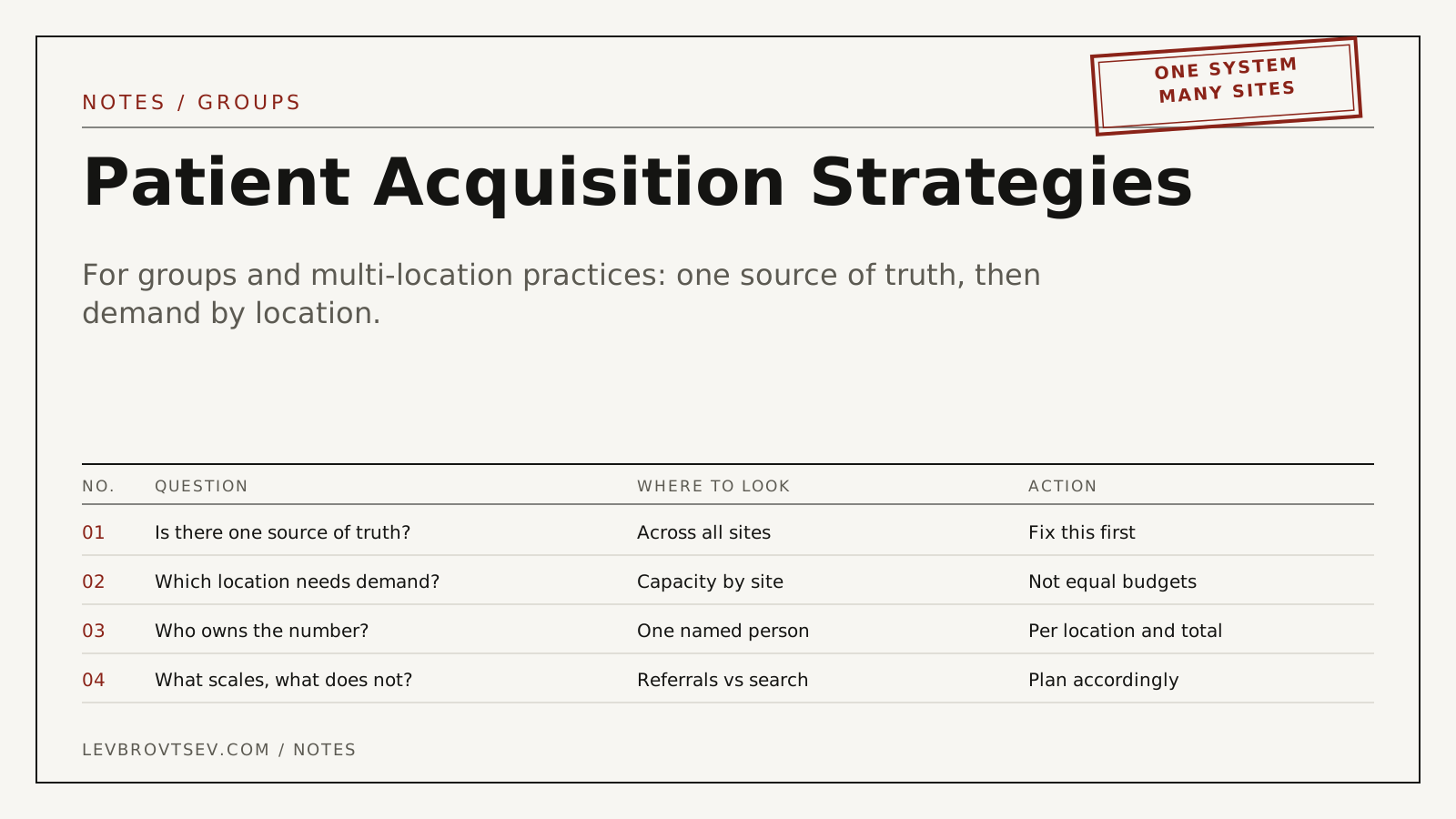
A single practice with a marketing problem has one funnel to inspect. A group has one funnel per location, plus a central budget, plus a report that averages everything into a number nobody can act on.
The tactics are the same ones in how to get more patients. What changes is the plumbing.
What changes when you have more than one location
Three things. Enquiries can arrive for the wrong site and need routing. Performance differences between locations get hidden by averages. And the same marketing dollar produces different returns depending on which site has capacity this month.
None of those are marketing problems in the usual sense. They are operations problems that marketing budget makes more expensive.
The system, stage by stage
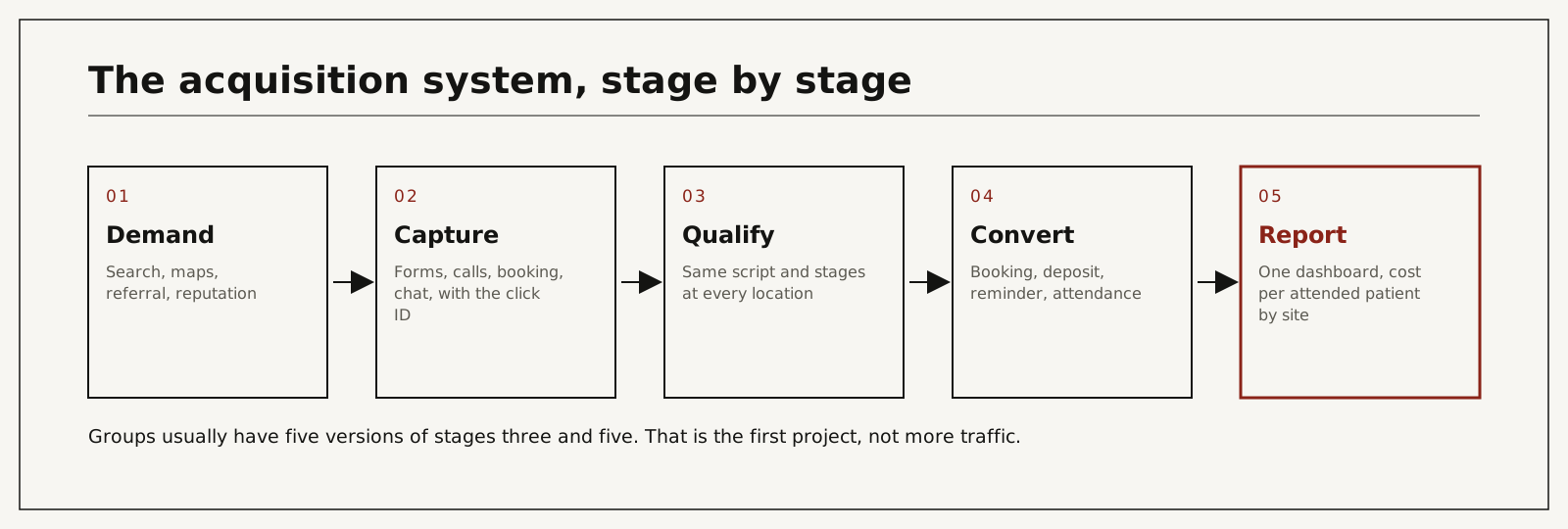
Demand. Search, maps, referral and reputation, per location. Each site needs its own Business Profile, its own reviews and its own local pages. Central content supports all of them.
Capture. Every form, call and booking widget at every site stores the source and the ad click ID. One standard, not per-location improvisation. See what a GCLID is.
Qualify. The same script and the same pipeline stages at every location. This is where most groups diverge, and it makes every downstream comparison invalid.
Convert. Booking, deposit where appropriate, reminders, attendance. Measured per site, because it varies far more by front desk than by marketing.
Report. One dashboard: enquiries, bookings, attended patients and cost per attended patient, by location and by procedure. The mechanism is the offline conversion tracking loop, with the privacy design in click-ID-only conversion feeds.
Where groups lose patients
| Cause | What actually happens | Hidden cost | What you see | Risk level |
|---|---|---|---|---|
| Different stage definitions per site | Numbers cannot be compared | Budget moved on bad evidence | "Site B converts better" with no shared definition | High |
| Enquiries routed to the wrong location | Patient waits, or books elsewhere | Paid demand lost at the last step | Complaints about being transferred | High |
| One phone number for all sites | Attribution and routing both break | Half of demand unmeasured | Calls logged centrally, source unknown | High |
| Equal budgets across locations | The site at capacity gets more demand it cannot serve | Waiting lists at one site, gaps at another | Identical monthly spend per location | Medium |
| Same-city campaigns competing | You bid against yourself | Higher cost per click for both | Two campaigns, one auction | Medium |
| Central reporting only | A failing site is hidden by the average | Months before anyone notices | Group totals with no per-site view | High |
| Reviews managed centrally, thinly | Weak local profiles everywhere | Map pack lost at every site | Low review counts across the group | Medium |
How to split the budget
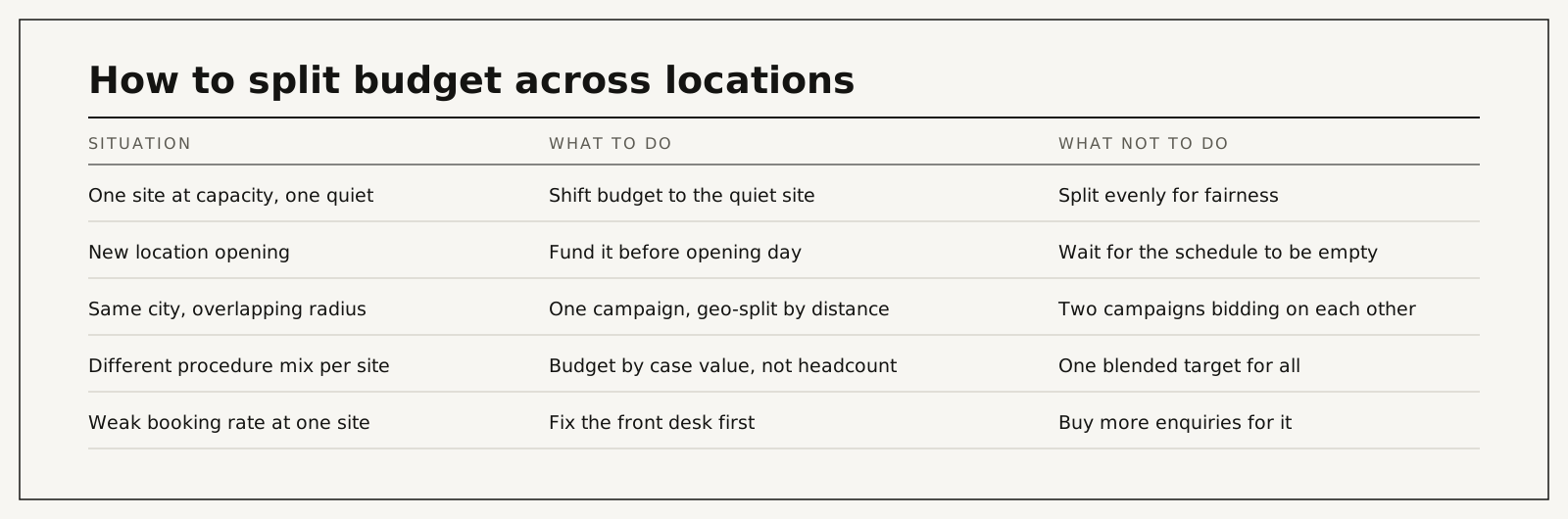
| Situation | What to do | What not to do |
|---|---|---|
| One site at capacity, one quiet | Shift budget to the quiet site | Split evenly for fairness |
| New location opening | Fund it before opening day | Wait for an empty schedule |
| Same city, overlapping radius | One campaign, geo-split by distance | Two campaigns in one auction |
| Different procedure mix per site | Budget by case value, not headcount | One blended target for all |
| Weak booking rate at one site | Fix the front desk first | Buy more enquiries for it |
The last row is the one that costs the most. Pushing budget at a location that converts poorly means paying full price for demand that leaks at the desk.
Same-city locations and the cannibalisation problem
Two clinics ten minutes apart, each with its own campaign on the same keywords, are bidding in the same auction. Google will not merge them for you, and the result is a higher cost per click for both, with attribution split arbitrarily between them.
Run one campaign for the shared service area, segmented by geographic distance, and route the enquiry to the nearer site at the capture stage. Keep separate campaigns only where the service areas genuinely do not overlap. The same principle applies to Performance Max, which is worse at respecting your intended boundaries: see Performance Max and brand cannibalization.
What it costs to put right
Market figures were checked in September 2026 for the US and Canada. They are ranges, not quotes.
| Route | Typical cost | Time to one source of truth | What it depends on |
|---|---|---|---|
| Internal standardisation project | Staff time across sites | Weeks to months | Whether the group shares one CRM |
| Developer work on capture and routing | Upwork lists tag manager specialists at $20 to $49 an hour, median $30; senior US consultants at $85 to $175 | Days to weeks | Number of entry points per site |
| Agency managing all locations | 10% to 20% of ad spend, or $2,500 to $7,500 a month for mid-sized accounts | Their queue | Whether they report per location |
| I build the measurement and run the media | Audit at $500 per ad account with a 90-day plan, credited toward the first month. Retainers from $5,000 a month, adjusted to budget and workload | Scoped in the audit | Sites, systems, sign-off |
| Carry on with averages | Nothing new | Never | A weak site stays hidden |
The audit covers your ad account, the tracking and the path from enquiry to booked patient, and ends with a 90-day plan. It is credited toward the first month if you continue with me.
You work with me directly. There are no account managers and no juniors.
The monthly review
- Enquiries, bookings and attended patients per location.
- Cost per attended patient per location and per procedure.
- Capacity per location: turning people away, or waiting for them?
- Routing errors: enquiries that reached the wrong site.
- One decision per location: more budget, same, or fix operations first.
Fix stage three before buying stage one
Before the next budget increase, check that every location defines a booked patient the same way and that every enquiry carries a source. Groups that do this find they can move existing budget and grow without spending more. If you would like the standard built and the media run against it, start with the audit.
Frequently asked questions
Should each location have its own campaigns?
Only where the service areas do not overlap. Inside one city, run a single campaign segmented by distance and route at the point of capture, or you will bid against yourself.
How do we compare locations fairly?
By using identical stage definitions and identical capture, then comparing cost per attended patient rather than leads. Without shared definitions, the comparison is arithmetic on different things.
Should budget follow revenue or capacity?
Capacity first, then case value. A site producing well but fully booked does not need more demand this month.
What if each location uses different software?
Then the first project is one place where all enquiries land, even if clinical systems stay separate. Marketing needs a single view of source, stage and outcome.
How many locations before this needs a dedicated person?
Usually around three to five, or earlier if the sites have different procedure mixes. Below that, a consultant plus one internal owner is normally enough.
Do we need separate phone numbers per site?
Yes. One shared number breaks both routing and attribution, and those are the two things a group most needs to get right.
Who does the work if I hire you?
I do: the media, the measurement standard and the reporting. Operations at each site stay with your team, which is where they belong.
How do we verify the system works?
Pick ten enquiries at random from last month across sites. You should be able to name the source, the location, the stage reached and the outcome for all ten. Anything less and the reporting is estimating.