Notes
Why Meta brings cheaper qualified leads than Google, and why Meta alone fails
 LEV BROVTSEV · OCTOBER 20, 2026
Meta often wins on cost per qualified lead because you pay for attention, usually per thousand impressions, not for a contested high-intent click, and its algorithm finds people before they search. But Meta can't replace search. Meta creates demand; Google and Bing capture it. Meta's volume, policy and data limits cap how far you can scale on it alone.
Every owner who compares Facebook ads vs Google ads in a channel report eventually asks the same question. Meta's cost per lead is a fraction of Google's, so why not move everything there? It's a fair question, and in one account I run the answer on cost alone was even stronger than the cost-per-lead report suggested. Here is what the numbers showed, why Meta wins on that metric, and why I still keep search at the center of the budget.
Key takeaways
- In one luxury US healthcare clinic, Meta was about 3× cheaper per verified patient than Google Ads, counted in the CRM, not in either platform's reporting.
- Meta is cheaper because the auction is less contested, it reaches people before they compare, and the creative does part of the qualifying.
- It doesn't scale alone: costs rise as spend grows, some of Meta's "cheap" patients finish their journey on Google, and one policy decision can stop the channel.
- Split budget by the marginal cost per verified patient in each channel, re-checked monthly, with one holdout test a quarter.
Contents
The number from one account
In a luxury US healthcare clinic I run paid acquisition for, Meta was about 3× cheaper per verified patient than Google Ads over the same period. Indexed, with Google Ads at 100, Meta came in at about 33.
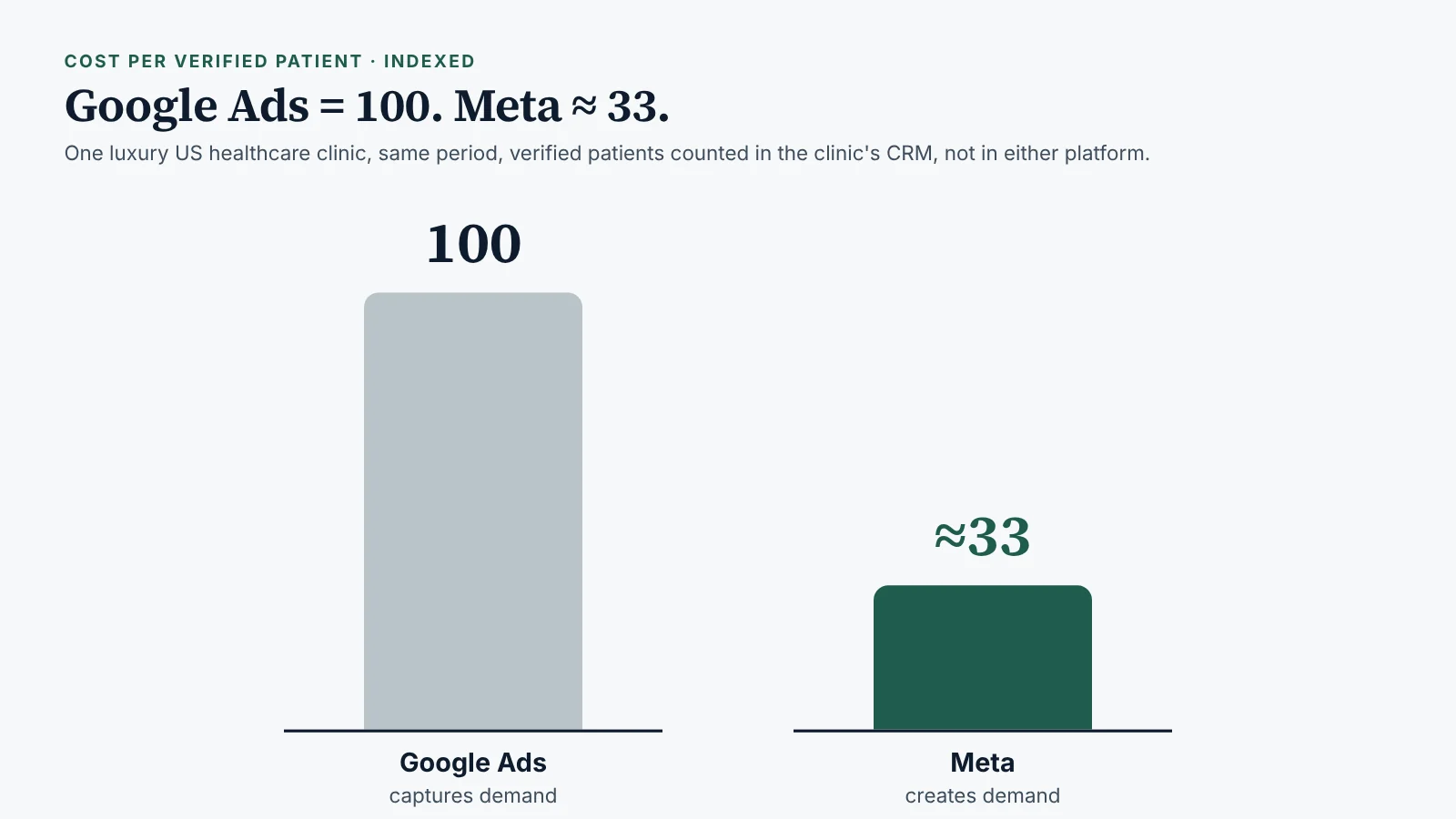
How it was counted matters more than the ratio. Verified patients came from the clinic's CRM, not from Meta Ads Manager or the Google Ads interface. Each verified patient was matched to the click ID or the Meta lead ID it arrived with, and spend and verified patients covered the same period. Platform-reported conversions played no part in the comparison. If your CRM doesn't record where each lead came from, that has to come first; the setup is in lead source tracking.
And I still wouldn't move the Google budget to Meta. The rest of this note is why.
Why Meta's qualified leads are cheaper: five reasons
1. You're buying attention, not a contested click
In Google Ads you bid on a search. Every clinic, aggregator and lead seller in your market wants the same query, and healthcare terms sit near the top of what anyone pays per click. Published tables are rough, and I explain why in Google Ads benchmarks for healthcare, but nobody disputes the direction. On Meta you usually pay per thousand impressions, in an auction shared with every consumer brand on the platform. The people you want aren't being fought over the way a high-intent search is.
2. You reach people before they compare
By the time someone types a treatment and "cost" into Google, they have usually opened several tabs. They're comparing you on price and convenience. Meta reaches them earlier, while the idea is still forming, and your practice is often the first one they take seriously. Fewer comparison shoppers means more of the leads that remain are worth a call.
3. The creative does the qualifying
A search ad has a few lines of text. A Meta ad can be a video of the founder explaining who the treatment is for, what it costs to start, and who shouldn't book. People who aren't a fit scroll past. That filtering happens before the click, which is why a lead from a well-made video ad tends to be further along than a lead from a short search ad.
4. Lead forms remove friction
Meta's instant forms let someone ask for a call without leaving the app or loading your site. That lowers cost per lead sharply. It also lets in people who tapped by accident or don't remember asking, which is the first limit below.
5. You can feed it outcomes, within limits
Meta's algorithm finds more of whatever you tell it counts. Send it form fills and it finds form fillers. Send it CRM outcomes through the Conversions API, a qualified or booked stage with a neutral event name, and it can learn from people who actually become patients. In this account that feedback is a large part of why the cost per verified patient held.
Health advertisers have less room here than other businesses, and it's worth checking your own status before you plan around it. Meta's Business Tools Terms don't allow data that includes or is based on health information, and event and audience names can't imply it. For websites it classifies under health and wellness, Meta may restrict specific mid- and lower-funnel events or fully restrict event sharing (Meta Business Help: data sharing restrictions). In practice that means: no condition or treatment in event names, parameters or URLs, a CRM ID instead of personal details, and a look at your dataset in Events Manager to see which events Meta still lets you optimize toward.
Why you can't run on Meta alone: six reasons
1. There's a volume ceiling
The first part of a Meta budget reaches the most responsive people in your audience. Each extra dollar reaches people who are a little less likely to act, and the same people see your ads more often. Frequency climbs, the creative wears out, and the cost of the next qualified lead rises even while the average still looks good.
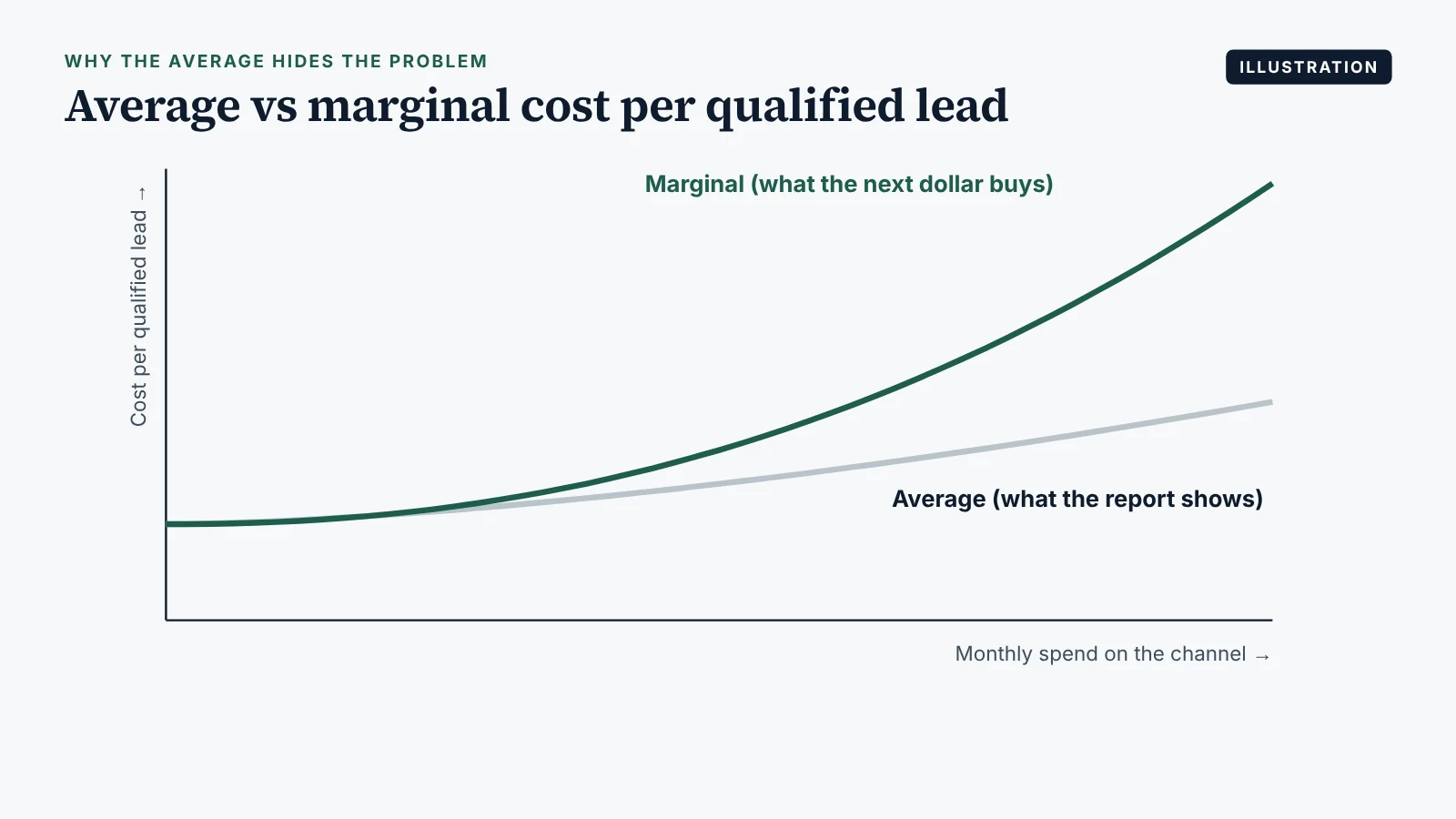
That gap between average and marginal cost is the trap. The report shows the average, so the channel looks cheap right up to the point where the last part of the budget is buying leads at several times the headline rate.
2. Search captures the demand Meta creates
Many people who see a Meta ad don't tap it. They search the clinic's name or the treatment a day later on Google or Bing, click a search ad or an organic result, and become a "search" patient. Turn search off and part of Meta's apparent performance goes with it, because those people now find a competitor's ad for your name or for the treatment.
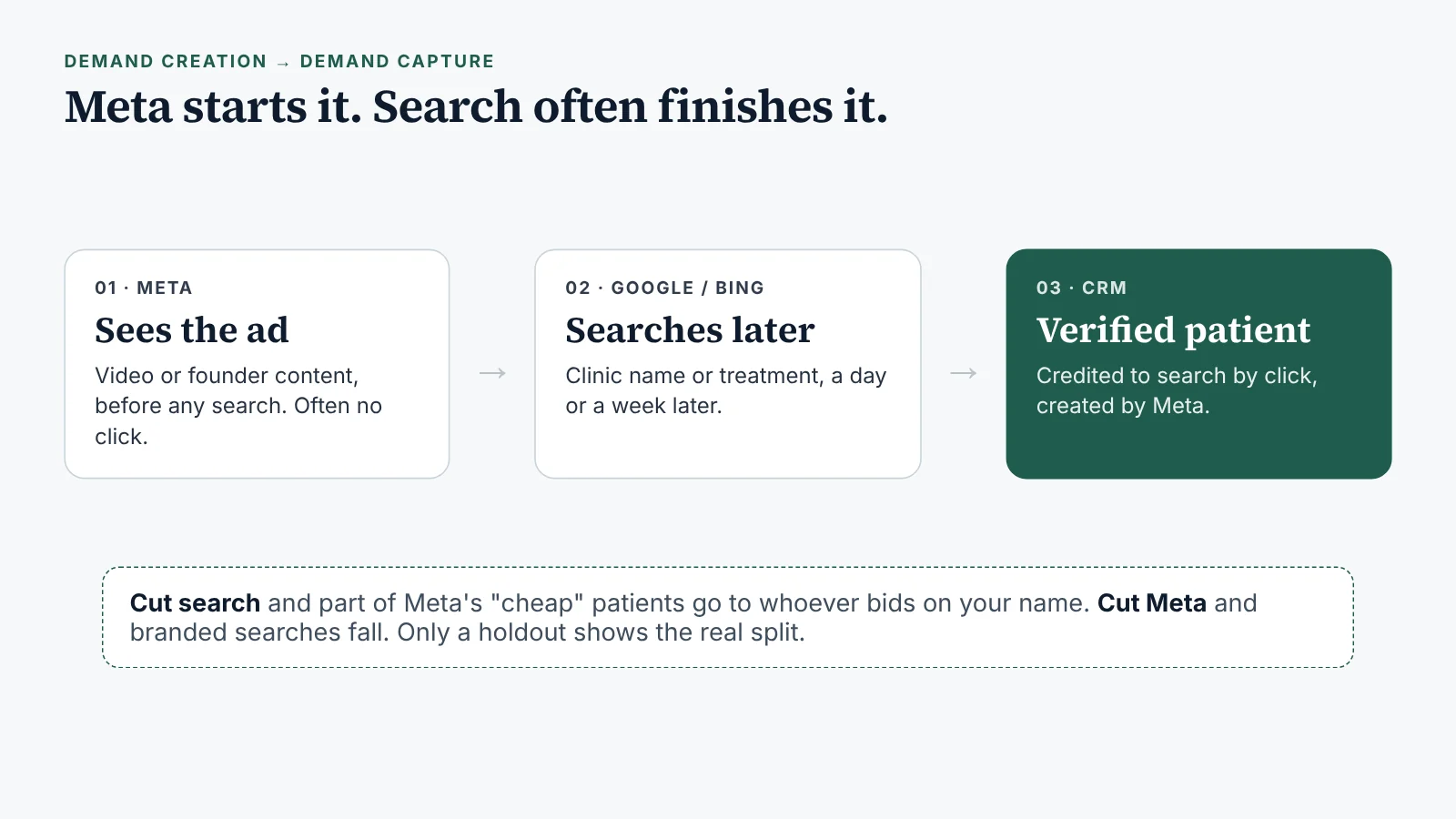
You can see this effect in branded search: when Meta spend goes up, searches for the practice name tend to follow. The only clean way to measure it is a holdout. Pause Meta in a set of comparable regions for a few weeks, or run Meta's own lift study, and compare verified patients from all channels against the regions where it kept running.
3. Lead quality has a wider spread
Instant forms bring more junk: wrong numbers, people who don't remember the ad, people who wanted information and not a call. Meta's cost per lead holds only if intake calls back within minutes, because these leads cool faster than a searcher who was actively shopping. If your front desk calls back the next morning, Meta's advantage disappears. What every minute costs in high-ticket covers the intake side.
4. Policy and account risk
Healthcare ads on Meta run under its health and wellness ad standards. Ads can't imply that the viewer has a condition, and some categories need LegitScript certification before either Google or Meta will run them. Disapprovals and restricted accounts happen even when the ads are compliant. One channel means one point of failure: a single review can stop all new patients for weeks. In my own experience, account bans stopped once I became an official Meta partner. That's what happened on the accounts I run, not a guarantee.
5. Meta's own reporting flatters Meta
Meta Ads Manager counts conversions that happened after someone only saw an ad, within its attribution window. Google Ads counts by click. Put the two dashboards side by side and Meta looks better than it is, because it's claiming some patients who also clicked a search ad. The only fair comparison is the one above: verified patients in your CRM, each matched to the click ID or lead ID it came with.
6. The highest intent is still on search
Someone typing the treatment plus "near me", "cost" or "financing" has already decided they want it. They convert faster and with fewer follow-ups than almost anyone Meta can reach. Those searches happen on Google and Bing, and if you're not there, a competitor is. Microsoft Ads deserves a place too: an older, higher-income audience, cheaper clicks and smaller volume, as I describe in when Microsoft Ads outperforms Google for high-ticket.
How I split the budget instead
I don't split by channel preference or by average cost per lead. I split by the marginal cost per verified patient in each channel: what the last part of each budget is buying, measured in the CRM, re-checked every month.
- Search first, for capture. Google and Bing get budget up to the point where the next increment costs noticeably more per verified patient than the rest. Beyond that point, extra search spend mostly buys the same people at a higher price.
- Meta for demand creation and retargeting. Prospecting with creative that qualifies, plus retargeting people who visited but didn't book. Budget goes up while its marginal cost per verified patient stays below search's.
- One holdout test a quarter. Pause one channel in comparable regions, or run a lift study, and see how many verified patients actually disappear. That number, not the dashboard, decides next quarter's split.
How I run the quarterly holdout. It doesn't need a data team, just discipline:
- Pick two groups of comparable regions, by past verified patients per month, not by population.
- Pause the channel you're testing in one group for four to six weeks. Leave everything else unchanged, including the other channels' budgets.
- Count verified patients from all sources in both groups, in the CRM, for the test period and the same period before it.
- The difference between the groups is roughly what that channel adds. If patients barely drop where it was paused, the channel was mostly collecting people who would have come anyway.
For a single-location practice, a geographic split isn't possible. Meta's own lift study, which holds out a random share of the audience, is the practical alternative there, where your account qualifies for one. Either way, the answer comes from the CRM, not from the platform that is being tested.
| Channel | Role | What to measure | When to cut |
|---|---|---|---|
| Google Search | Capture high-intent and brand demand | Marginal cost per verified patient; impression share on core terms | When the last increment costs far more per patient than the account average |
| Microsoft Ads | Cheaper capture from an older, higher-income audience | Cost per verified patient vs Google on the same terms | When volume is too small to read after 60 days |
| Meta prospecting | Create demand before people search | Verified patients, branded-search lift, holdout results | When frequency climbs and marginal cost passes search |
| Meta retargeting | Bring back visitors who didn't book | Verified patients not already in the pipeline | When it mostly reaches people who would have booked anyway |
All of this depends on counting patients, not leads; why that matters is the subject of cost per patient vs cost per lead. The CRM outcomes that feed Meta's Conversions API are the same ones you send back to Google through offline conversion tracking, so one setup serves both platforms.
The account this comparison comes from is the same one in my flagship case: an inherited account rebuilt around verified patients. How I run each channel is on the Google Ads, Meta Ads and Microsoft Ads pages.
Want to know which channel actually produces your patients? The paid audit is $500: one channel, one location, credited toward setup. I trace verified patients back to their source and show you where the next dollar should go.
15 minutes. With me, not a sales rep.
Diagnosis before treatment.
Frequently asked questions
Is Facebook advertising allowed for healthcare?
Yes. Clinics can advertise their services on Facebook and Instagram under Meta's health and wellness ad standards. Ads can't imply that the viewer has a condition, some categories need certification such as LegitScript, and websites classed as health and wellness face limits on the data they can share and the events they can optimize toward.
Can I use the Meta pixel on a clinic site under HIPAA?
Be careful. A pixel can send page URLs and actions that reveal what a visitor was looking for, and Meta doesn't sign a business associate agreement. The conservative setup keeps the pixel off condition-specific pages and forms, and sends Meta only a CRM ID and a neutral stage through the Conversions API. I'm not a lawyer; confirm your setup with counsel.
Should I use Meta lead forms or a landing page?
Lead forms are cheaper per lead and bring more low-intent submissions. A landing page costs more per lead but lets you capture the click ID and source, show the practice properly and filter with a qualifying question. If you use instant forms, choose the higher-intent form type, add one qualifying question and call back within minutes.
How much budget does Meta need before it works?
Think in events, not dollars. Meta's learning phase looks for about 50 optimization events a week per ad set. If your qualified or booked stage can't reach that, optimize toward a higher-volume stage, keep fewer ad sets, and judge the result by verified patients in the CRM rather than by what Meta reports.
How do I know Meta leads aren't people who would have searched anyway?
Run a holdout. Pause Meta in comparable regions for four to six weeks, or use Meta's lift study if your account qualifies, and compare verified patients from all channels against the regions where Meta kept running. The difference is what Meta adds. Platform dashboards can't answer this, because each one claims credit for the same patients.