Notes
Google Ads for Dentists: How to Get Booked Patients, Not Just Clicks
 LEV BROVTSEV · OCTOBER 28, 2026
Google Ads works for dental practices when the account is split by treatment, every search lands on a page about that treatment, and results are counted in patients seen and treatment accepted, pulled from your practice software. Run it on clicks and form fills and it will buy cheap clicks. Judge a rebuilt account after two to three months, not two weeks.
Key takeaways
- Search campaigns split by treatment (brand, emergency, implants, ortho, general) beat one "dental" campaign, because each gets its own budget, page and goal.
- Implant searches lead every other treatment in US demand and carry the highest case value. They deserve the largest budget and the strictest tracking.
- The step most agencies skip: sending booked, seen and accepted patients back into Google Ads, so bidding learns which searches become patients.
- The account should be in the practice's name. If you can't log in as an admin, you don't own your data.
- Remarketing on health topics is restricted by Google policy, and tracking on a dental site has HIPAA consequences. Search ads on intent are the clean core.
Want this built and run for your practice? I set up and manage Google Ads for US dental practices, measured in seen patients and accepted treatment, not clicks. You work with me directly: no account managers, no juniors.
- Account rebuilt by treatment: brand, emergency, implants, ortho, general
- Landing pages matched to each campaign, with price ranges and financing where you offer them
- Calls and forms tracked to your CRM or practice software, outcomes imported back into Google Ads
- Weekly search-term cleanup and a monthly report in patients, not clicks
- The account stays in your name; you pay Google directly
| Step | Price | What you get |
|---|---|---|
| Fit Call | Free, 15 min | We check fit and agree the next step |
| Paid audit | $500 | One channel, one location; credited toward setup |
| Setup | from $1,500 | Tracking and campaign rebuild, about 14 days |
| Management | from $2,000/month | One channel, up to 2 clinics, 3-month minimum |
Best fit: practices spending $5,000 or more a month on ads, or ready to. I don't take addiction-treatment or behavioral-health clients.
15 minutes. With me, not a sales rep.
Contents
- Dental Google Ads, done for you
- Does Google Ads work for dentists?
- Where is the demand?
- How should a dental Google Ads account be structured?
- Search, Performance Max or Local Services Ads?
- How much should a dental practice spend?
- Tracking to booked patients: the step agencies skip
- Rules that apply to dental ads
- Seven mistakes I find in dental accounts
- Frequently asked questions
Does Google Ads work for dentists?
Yes, for the part of dentistry where people search with a need and a deadline: a broken tooth tonight, implants after a failed bridge, aligners before a wedding. Search ads put you in front of that person at the moment they are choosing. Few other channels do.
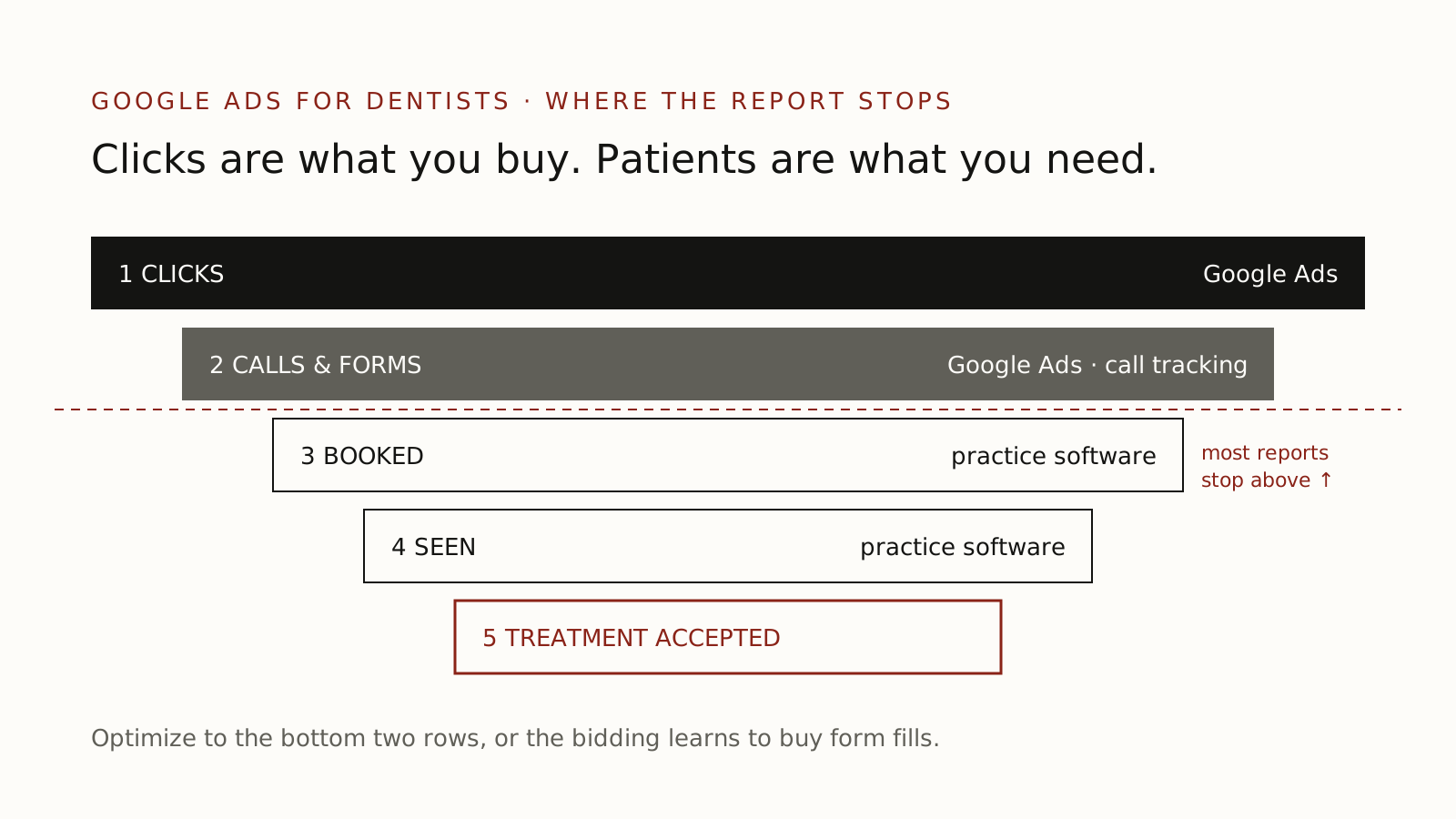
Where it fails is predictable. The account is one campaign for everything, the ads send people to the homepage, and the report counts "conversions" that are form views, 10-second calls and duplicate submissions. The bidding then does exactly what it is told: it finds more of those, cheaply.
My take: most dental accounts I review are not short of budget. They are short of truth. When the only number the algorithm sees is a form fill, you are paying Google to find people who like filling in forms. Fix what the account counts before you raise what it spends.
Where is the demand?
Implant searches lead every other treatment in US search volume, and they come with the largest case value. That combination is why implants should get the most money and the most careful tracking in a dental account.
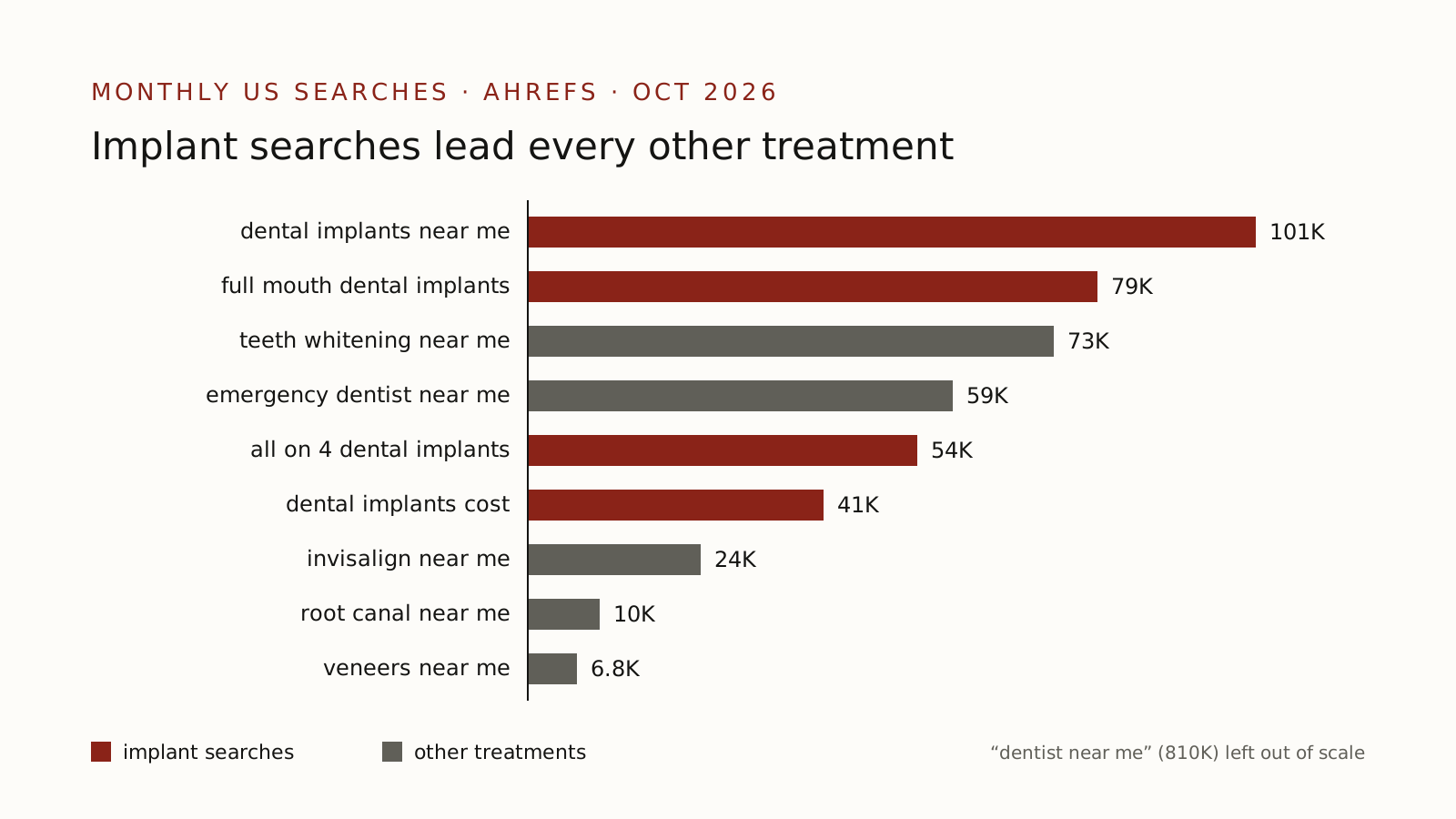
Two things follow. First, a click on "teeth whitening near me" and a click on "all on 4 dental implants" are not worth the same, so they should never share a budget. Second, volume is national. Your market is a radius around the practice, so check local volume and current bids in Google's own Keyword Planner before you set a number. Third-party tools are useful for comparing demand; they are unreliable for local cost per click.
How should a dental Google Ads account be structured?
One Search campaign per treatment line, each with its own budget, landing page and definition of success. Five campaigns cover most general and multi-specialty practices.
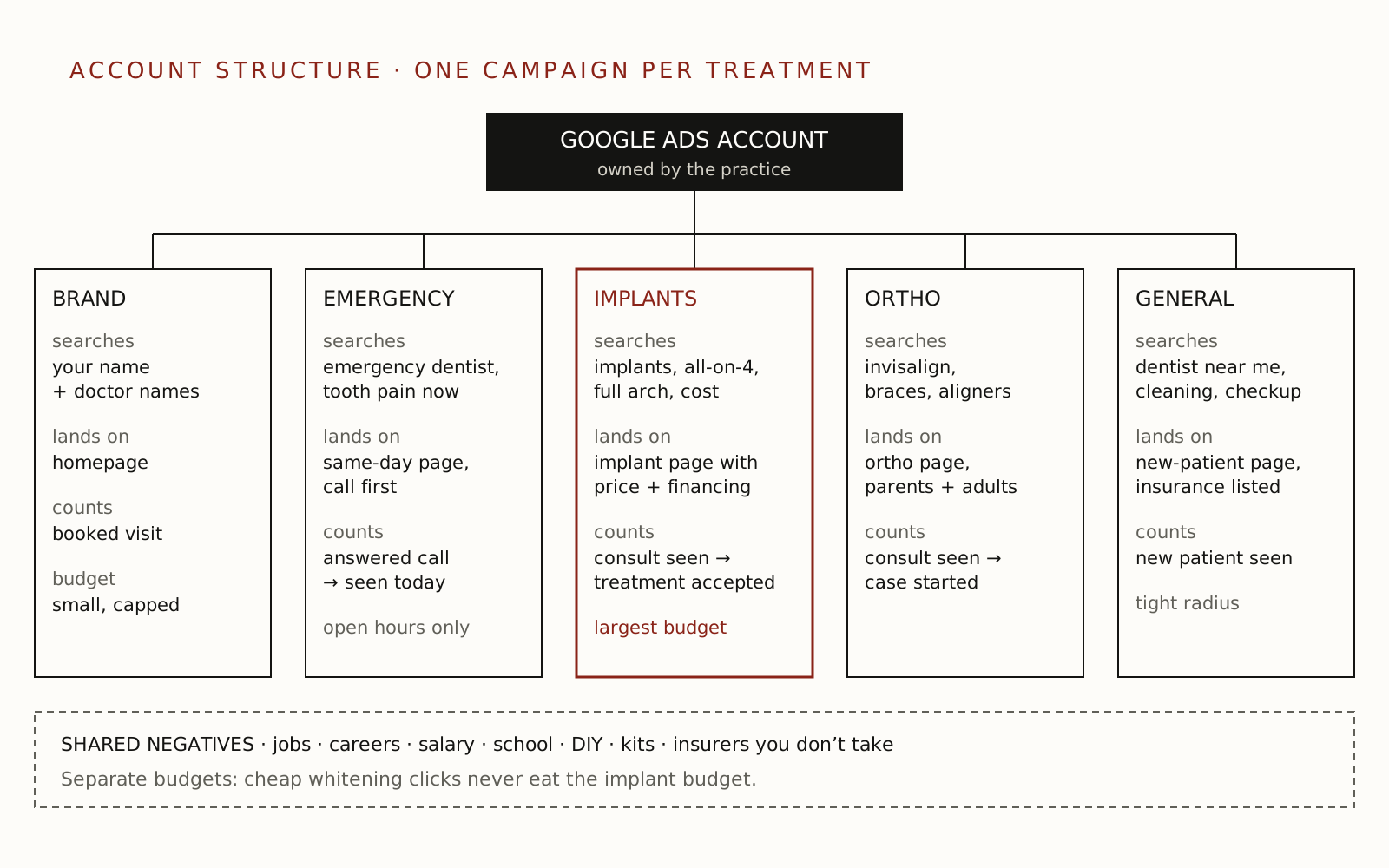
| Campaign | Typical searches | Landing page | What counts as success |
|---|---|---|---|
| Brand | Your practice and doctor names | Homepage | Booked visit |
| Emergency | Emergency dentist, tooth pain, same day | Same-day page, phone first | Answered call, seen the same day |
| Implants | Dental implants, all-on-4, full arch, implant cost | Implant page with a price range and financing | Consult seen, then treatment accepted with case value |
| Ortho | Invisalign, braces, clear aligners | Ortho page for adults and parents | Consult seen, case started |
| General | Dentist near me, cleaning, checkup | New-patient page with insurance listed | New patient seen |
Three details make the structure work. Use phrase and exact match with a shared negative list (jobs, careers, salary, school, DIY, kits, insurers you don't take) and read the search terms report weekly for the first month. Write ads that say what the page says: price range, financing, same-day availability, the doctor's name. And give each specialty its own page; the deeper version for implants is on my dental implant marketing page, and for orthodontics on orthodontic marketing.
Search, Performance Max or Local Services Ads?
Start with Search. Add Local Services Ads for general dentistry if you qualify. Add Performance Max only after the account sends real patient outcomes back to Google.
| Campaign type | Best for | Watch out for |
|---|---|---|
| Search | Treatment intent you can name: implants, emergency, aligners | Broad match without negatives; one campaign for everything |
| Local Services Ads | General and family dentistry; pay per lead, Google Screened badge | Little control over which leads you get; still track them to the chair |
| Performance Max | Scaling an account that already imports booked and accepted patients | Without offline conversions it chases cheap form fills and your own brand searches |
Performance Max is not bad. It is a fast learner fed with whatever you count. If you already run it, check how much of its spend is your own brand name; my note on Performance Max negative keywords shows how to fence it off.
How much should a dental practice spend?
Work backwards from the patients you want, not forwards from a round number. The math is four steps, and every input except the first comes from your own account and front desk.
- Cost per click for your treatment and radius, from Keyword Planner or your account history.
- Click to lead: the share of clicks that call or submit a form you would actually answer.
- Lead to seen: the share of those leads who book and show up.
- Seen to accepted: for implants and ortho, the share who accept a treatment plan.
Budget = target patients ÷ (lead rate × seen rate × acceptance rate) × cost per click. As a worked example with made-up round inputs, not benchmarks: a $20 click, 10% of clicks becoming leads, 40% of leads seen and 30% accepting gives about $1,670 per accepted implant case. Whether that is cheap depends on your case value. Your real inputs are already in your account and your schedule; the gap between "cost per lead" and "cost per patient" is covered in cost per patient vs cost per lead.
Below roughly $5,000 a month across several treatments, the budget is spread too thin for bidding to learn. Pick one treatment and do it properly instead.
Tracking to booked patients: the step agencies skip
Closing the loop means every call and form carries the click ID into your CRM or practice software, and outcomes go back to Google Ads as offline conversions. Then the bidding optimizes to seen patients and accepted treatment instead of to whoever fills in a form.
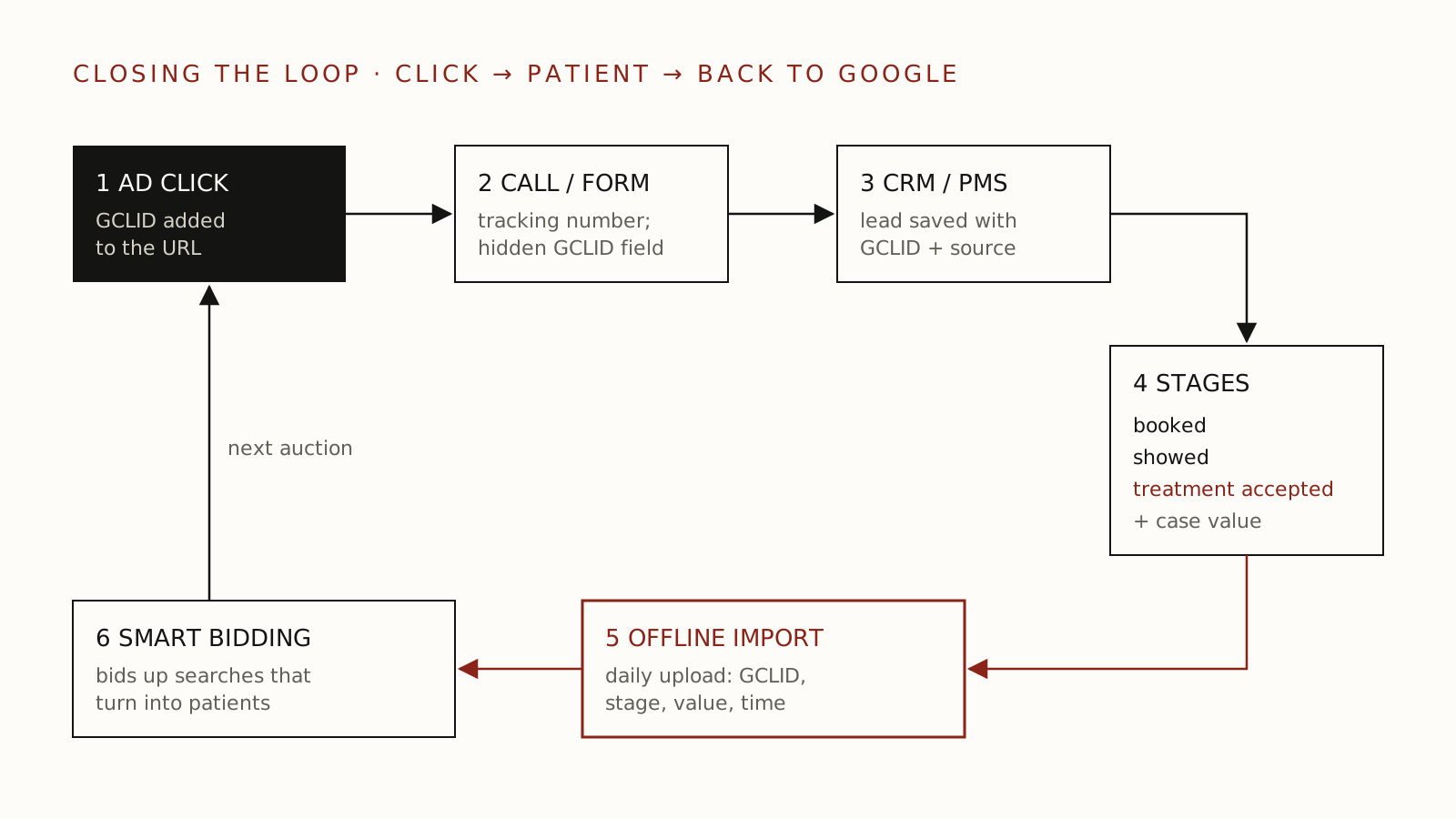
- Capture the click ID. Store the GCLID in a hidden form field and pass it into the CRM. For calls, use call tracking that records the click and connects the caller to it, without sending clinical details to ad platforms. More in dental call tracking without breaking HIPAA.
- Track the stages. Booked, showed, treatment accepted, with a value for accepted cases. The front desk already records most of this; it just needs to sit next to the source.
- Send it back. Upload or sync those stages to Google Ads every day as offline conversions. The full setup is in offline conversion imports, and for Salesforce in GCLID to Salesforce.
- Change what the bidding optimizes to. Make "seen" or "accepted" the primary conversion and demote form fills to secondary.
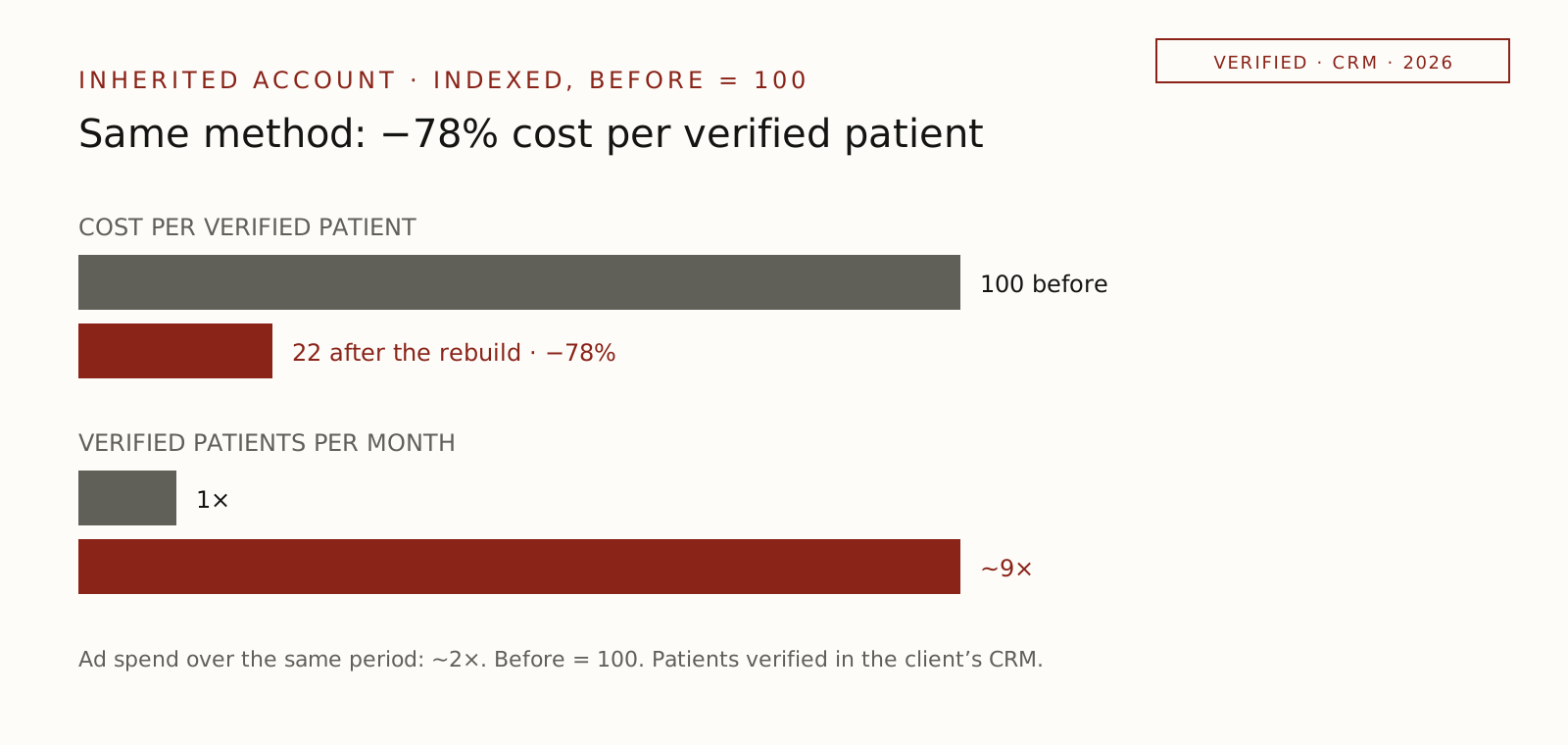
This is the method I used when I inherited a wasteful account at a luxury US healthcare clinic. It isn't a dental practice, but the mechanics are identical: once the account was rebuilt around verified patients, cost per verified patient fell about 78% while spend roughly doubled.
For multi-location implant groups the tracking breaks in specific ways: two CRMs, the wrong pixel, accounts owned by the agency. I wrote up eight tracking mistakes from a real implant-group audit.
Rules that apply to dental ads
Search ads on treatment keywords are the clean core of dental advertising. Two rules shape what you build around them.
- Google's personalized advertising policy. Remarketing and custom audiences built around health conditions are restricted under the personalized advertising policy. Don't build a strategy on retargeting people who read about gum disease or dentures.
- HIPAA and tracking. Dental practices are covered entities. The HHS guidance on online tracking technologies explains when tracking can disclose patient information to vendors; part of it was set aside by a federal court in 2024, so treat it as a risk map and ask your compliance counsel. In practice: no clinical details in URLs, form names or ad events, and a hard look at what your pixels send. See is Google Analytics HIPAA compliant?
Seven mistakes I find in dental accounts
- One campaign for every treatment. Whitening clicks spend the implant budget.
- The homepage as the landing page. An implant searcher has to hunt for implants.
- Conversions that aren't patients. Page views, button clicks, calls under 60 seconds and duplicate forms all counted as wins.
- Broad match without a negative list. Dental jobs, dental schools and DIY kits on your bill.
- Performance Max feeding on your brand. It reports great results on people who were already searching for you.
- An account in the agency's name. When you leave, the history and the learning stay with them.
- No link between the ad report and the schedule. Nobody can say how many patients last month's spend produced.
If you recognize three or more, start with the questions in questions to ask your dental marketing agency, or run the checks in how to audit your Google Ads agency yourself. If you want it done for you, that's what dental PPC covers.
If you'd rather have someone check this in your own account: the paid audit reviews your Google Ads structure, search terms, conversion setup and the path from click to booked patient, and ends with a written plan. It costs $500 per channel, per location, and is credited toward setup if we work together. It starts with a 15-minute Fit Call. I don't take addiction-treatment or behavioral-health clients.
15 minutes. With me, not a sales rep.
Frequently asked questions
How much do Google Ads cost for a dentist?
It depends on the treatment and the radius. Check current bids for your area in Google's Keyword Planner, then work backwards: target patients divided by your lead, show and acceptance rates, times cost per click. Below roughly $5,000 a month, focus on one treatment rather than spreading the budget thin.
How long does it take for dental Google Ads to work?
Clicks start the day ads go live. A rebuilt account usually needs two to three months to judge, because bidding has to learn from booked and seen patients, and implant cases take weeks to move from consult to accepted treatment.
Should a dental practice use Performance Max?
Only after the account sends real patient outcomes back to Google as offline conversions. Without them, Performance Max optimizes to the cheapest form fills and often takes credit for your own brand searches.
Can I retarget website visitors with dental ads?
Be careful. Google's personalized advertising policy restricts targeting based on health conditions, and tracking on a dental site has HIPAA implications. Search ads on treatment keywords are the safer core.
Who should own the Google Ads account?
The practice. You should have admin access and pay Google directly. If an agency owns the account, the history and the learning leave with them when you switch.