Notes
AI Visibility Trackers for Clinics: What They Actually Measure (and How to Check It Yourself)
 LEV BROVTSEV · OCTOBER 15, 2026
There is no ranking in ChatGPT. AI answers change with the wording, the location, the account, chat memory and whether search is on, and nobody outside OpenAI and Google has prompt-volume data. Trackers sample prompts a vendor wrote, from a data center. To know what patients see, run real patient questions yourself.
Key takeaways
- "ChatGPT ranks you #4" describes one sample of a random output, not a position you hold.
- The same question can name different practices on the next run, in another city, or in a logged-in account with history.
- Most trackers use vendor-written prompts sent by script from data centers, one to three runs each. At best they show a rough trend over months.
- A manual check takes about an hour: 5 to 10 real patient questions, five assistants, a VPN set to your city, three runs each, one log.
- What moves answers is ordinary and checkable: one page per treatment, credentials in schema, Google reviews, a consistent name, address and phone.
Contents
The pitch clinics are getting
The email usually opens with a number. "ChatGPT ranks your practice #4 for best dentist near me. Your competitor is #1." Then comes an offer of a 15-minute call to walk through it, a free report with a chart, and at the end a monthly subscription to keep watching the number and, for a larger fee, to improve it.
It works because the question behind it is real. Patients do ask assistants which practice to choose, and owners hear it at the front desk: "ChatGPT recommended you." Wanting to know whether you appear is reasonable. The problem is the number. A position in an AI answer is not something your practice holds from one day to the next, so a report built around it measures something that doesn't exist in the form it is sold.
Why is there no ranking in AI answers?
There is no ranking because there is no fixed list to rank on. A search results page is the same ordered list for everyone who sees it at that moment. An AI answer is generated fresh each time, and the practices it names depend on conditions the person asking controls and the tracker usually doesn't.
The answers are non-deterministic
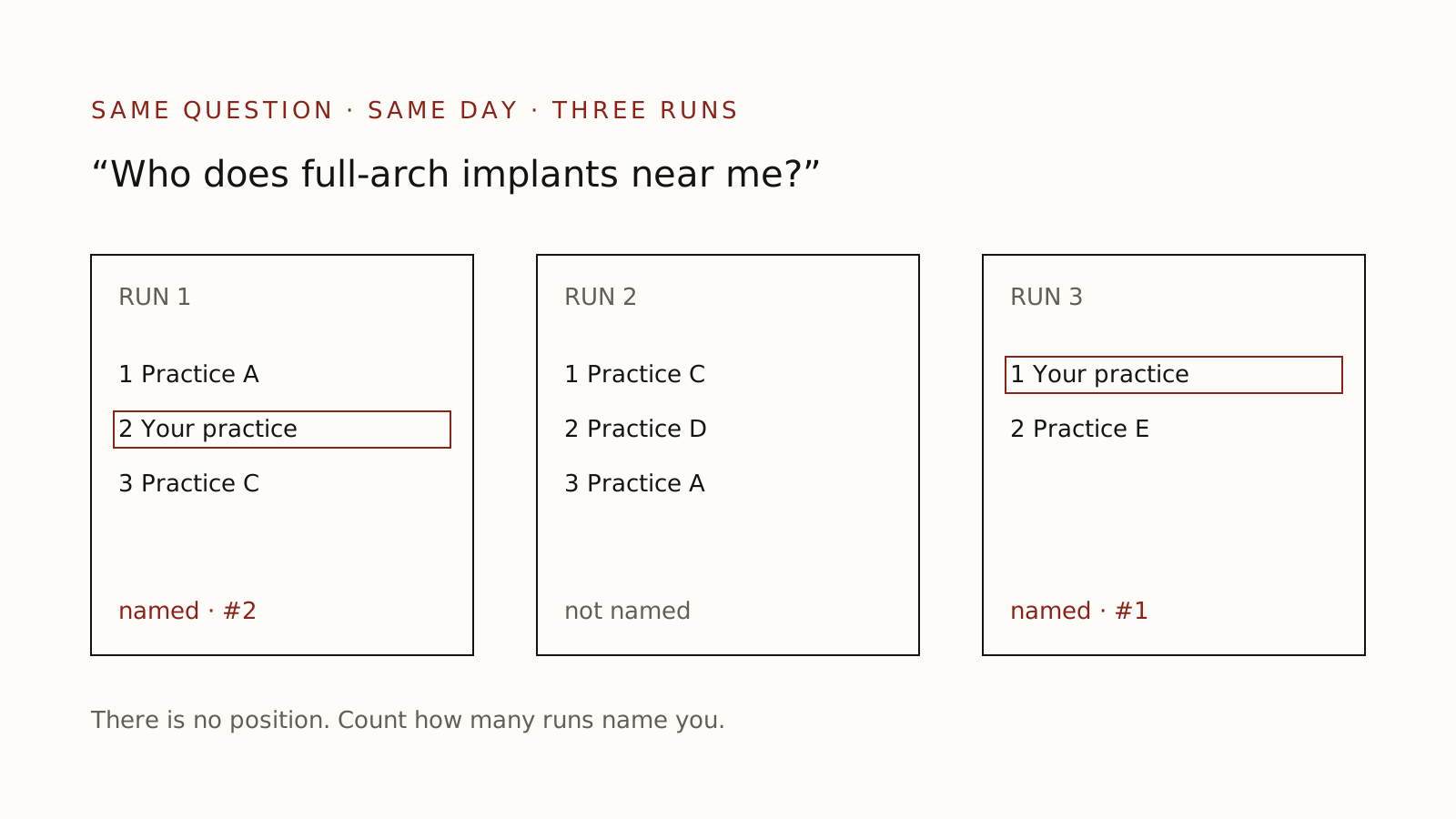
Language models produce text by sampling. Ask the same question twice in a row and you can get a different set of practices, in a different order, with different reasons. That is how the systems are designed, not a fault. A single answer tells you what was said once.
They depend on context you can't see in a report
The practices named shift with the exact wording ("implant dentist" versus "dentist for dental implants"), with the location the assistant infers, with whether the person is logged in and what the account already knows, with memory from earlier chats, and with whether web search is switched on for that answer. A report rarely states which of these conditions applied to its number.
Nobody outside the platforms knows what patients ask
Search keyword tools estimate how often a phrase is searched. No equivalent exists for prompts. The only parties who know how often patients ask a given question are the platforms themselves, chiefly OpenAI and Google, and they don't publish it. When a tracker says a prompt "matters", it is a guess about relevance, not a measure of demand.
How do AI visibility trackers work?
Most AI visibility trackers send a fixed list of prompts to the assistants on a schedule and count how often your name appears in the answers. The method is easy to automate and easy to chart. Each step in it moves the result further from what a patient in your city actually sees.
- The prompt list is written by the vendor. It is usually generated from your category and city, not taken from questions your patients ask on the phone or in reviews.
- The prompts run by API or script from data centers. There is no real location, no account history and often no web search in the same form a consumer app uses, so the answer can differ from what the app shows a patient.
- Each prompt runs one to three times. On output that changes between runs, a handful of samples cannot separate a real change from chance.
- "Share of voice" is computed from those samples. A percentage with one decimal place looks precise. It inherits all the randomness above.
Used carefully, this can show a rough trend over several months: whether you are named more often than before across a fixed set of prompts. It should not decide a budget, a hire or a content plan on its own. If you already use a tool, my note on AI search monitoring tools and the method behind them covers how to read one honestly.
| What the report says | What was measured |
|---|---|
| "You rank #4 in ChatGPT" | Your name came fourth in one or a few sampled answers to one prompt the vendor chose |
| "Share of voice 23.4%" | Mentions divided by answers, across a small number of runs on a vendor-written prompt list |
| "Visibility dropped this week" | Different samples from a system that varies between runs; possibly no change at all |
| "High-volume prompt" | An estimate; prompt volumes are not published outside the platforms |
| "Visible in your city" | Usually a city named inside the prompt, sent from a data center elsewhere |
How to check your practice yourself
You can check what patients see in about an hour, with no subscription. The point is to copy the conditions a patient is in, and to repeat each question enough times that one lucky or unlucky answer doesn't decide the result.
- Write down 5 to 10 real patient questions. Take them from the front desk, call recordings, reviews and the "how did you hear about us" field. Use the patient's words: "Who does same-day crowns near Midtown?" rather than "cosmetic dentistry services".
- Use the assistants the way a new patient would. ChatGPT in a temporary chat with search on, Gemini in an incognito window, Google AI Mode, Perplexity and Copilot. Stay logged out wherever you can, so your own history isn't in the answer.
- Set a VPN to your clinic's city. Location changes which practices are named. A check run from your office network or from another city tests the wrong place.
- Run each question three times. Start a fresh chat for every run. Three runs show whether a mention is stable or a coin toss.
- Log every run. Note whether the clinic is mentioned, what is said about it, and which sources the assistant cites. The sources tell you what to fix: an old directory listing, a review site, a competitor's page about your treatment.
A simple log is enough. One row per run:
| Date | Assistant | Question | Run | Mentioned? | What was said | Sources cited |
|---|---|---|---|---|---|---|
| Oct 15 | ChatGPT, temporary chat, search on | Who does full-arch implants near me? | 1 of 3 | Yes, second of three | "Offers All-on-4 and sedation" | Practice site, Google reviews |
| Oct 15 | ChatGPT, temporary chat, search on | Who does full-arch implants near me? | 2 of 3 | No | — | Two competitor sites, a directory |
| Oct 15 | Perplexity | Who does full-arch implants near me? | 1 of 3 | Yes, first | Old address | Outdated directory listing |
Example rows show the format, not real results.
Read the log as a count: named in 2 of 3 runs on ChatGPT, 0 of 3 on Gemini, 3 of 3 on Perplexity with the wrong address. That tells you more than a single position, and it tells you where to act. Repeat the same questions every month or two and compare counts.
What actually moves AI answers
AI answers move when the sources assistants read describe your practice clearly, consistently and verifiably. None of this is exotic, and all of it can be checked by looking at your own pages and listings.
- One page per treatment or service. An assistant asked about veneers looks for a page about veneers. A single "services" page listing twenty treatments rarely gets quoted for any of them. Put a direct answer at the top of each page; more on that in how clinics get cited by ChatGPT and Perplexity.
- Schema that says who you are. Mark up the practice as Dentist or MedicalClinic, and your clinicians with hasCredential for degrees, board certification and accreditation. Link licenses to the official verification page of the state board, so the claim can be confirmed. The mechanics are in llms.txt, schema and extractability.
- Google reviews and your Business Profile. Reviews and the profile are among the sources assistants cite for local questions. Keep categories, services and hours current, and answer reviews. See local SEO for practices.
- The same name, address and phone everywhere. When directories disagree, assistants repeat whichever version they found. Fix the listings that appear in your log's "sources cited" column first.
- Directories that matter in your field. Professional and insurer directories are fetched often and trusted. An accurate listing there does more than a new blog post.
Google describes how its own AI features use pages in its documentation for site owners: the same fundamentals as search apply. There is no separate trick for AI.
If you'd rather have this done properly: the paid audit includes a manual AI visibility check. I run your real patient questions in ChatGPT, Gemini, Google AI Mode and Perplexity, three runs each, with a VPN set to your city, and log what is said and which sources are cited, alongside a review of one ad channel and your tracking. It costs $500 per channel, per location, and is credited toward setup if we work together. It starts with a 15-minute Fit Call to confirm fit.
15 minutes. With me, not a sales rep.
If someone shows you an AI position, ask them to reproduce it live.
Frequently asked questions
Does my practice show up in ChatGPT?
Ask it the way a patient would, in a temporary chat with search on, from your city, three times. If you are named in most runs, you show up for that question. If you are named once in three, it is chance. Repeat with five to ten real patient questions before drawing a conclusion.
Is a ChatGPT ranking report worth paying for?
Not as a ranking. There is no fixed position in an AI answer, and most reports sample vendor-written prompts a few times from a data center. A tracker can show a rough trend over months. A manual check from your city with real patient questions tells you more about what patients see.
How does a healthcare practice appear in AI search?
By being easy to describe and easy to verify: one page per treatment with a direct answer at the top, Dentist or MedicalClinic schema with credentials, licenses linked to official verification pages, current Google reviews and Business Profile, and the same name, address and phone across directories.
How often should I check?
Every month or two is enough. Use the same questions, the same assistants and the same city each time, and compare how many runs name you. Weekly checks mostly record noise from a system that varies between runs.
Do reviews change what ChatGPT says about my clinic?
They can. For local questions, assistants often cite Google reviews and business profiles, and they repeat what those sources say. Your log's "sources cited" column shows whether reviews are among the sources for your questions.